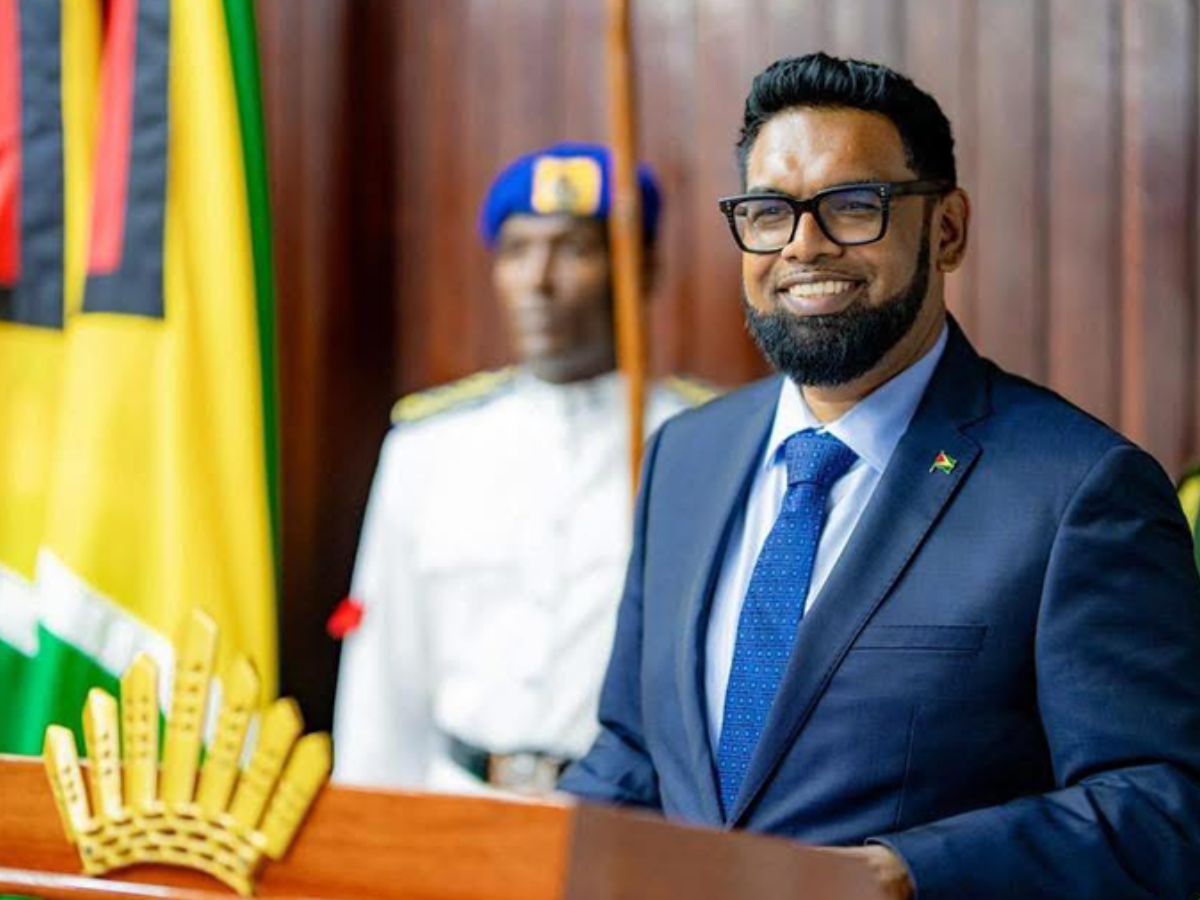
President Irfaan Ali of Guyana told business leaders in New York this week that regional peace and democratic governance are prerequisites for the foreign investment his country needs to sustain one of the fastest rates of economic growth in the world. He was speaking at a forum hosted by the Consejo Empresarial Alianza por Iberoamérica, held alongside engagements tied to the United Nations General Assembly.
Guyana's economy has been transformed over the past decade by offshore oil production, which began after ExxonMobil discovered vast reserves in the Stabroek Block in 2015. Growth forecasts for the country remain exceptional by international standards, with the International Monetary Fund projecting expansion in the low twenties, in percentage terms, for the current year. That scale of growth places Guyana ahead of every other national economy tracked by the fund, though the underlying base remains small and a large percentage increase still represents a modest sum in absolute terms.
President Ali used his address to argue that oil revenue alone will not deliver the diversification Guyana needs. Roads, ports, housing and agricultural infrastructure require capital, technical expertise and partnerships that extend well beyond the energy sector. He told the gathering that attracting that capital depends on investors believing the wider region is governed predictably and peacefully, a condition he said cannot be taken for granted in South America.
That argument rested heavily on the question of hemispheric security. President Ali pointed to multilateral frameworks, including the United States-backed Shield of the Americas initiative launched earlier this year, as mechanisms that reassure financiers by protecting trade corridors and territorial boundaries across the region. Without such frameworks, he suggested, the political risk premium attached to South American investment would remain too high for many institutional investors to accept.
Much of the speech's context was shaped by Guyana's long-running border dispute with Venezuela over the Essequibo region, which makes up roughly two thirds of Guyana's territory and sits atop much of its oil wealth. Venezuela has never accepted the boundary drawn by an 1899 arbitral tribunal and reaffirmed by an 1905 demarcation agreement, and the dispute escalated sharply in 2023 when Caracas held a referendum asserting sovereignty over the territory. Guyana has consistently refused to negotiate the matter bilaterally, insisting instead that the case be settled by the International Court of Justice, where proceedings are ongoing.
President Ali reiterated that position in New York, framing Guyana's reliance on the ICJ not merely as a legal strategy but as evidence of the kind of rules-based conduct he believes the region must demonstrate to attract long-term capital. He argued that both Guyana and Venezuela stand to benefit from a peaceful resolution, since neither country can realise the full value of its resources while the dispute deters the sustained investment that large infrastructure and energy projects require.
The address drew attention beyond the immediate business audience because it linked Guyana's domestic growth story to broader questions about hemispheric stability at a moment when Washington has been recalibrating its engagement with Latin America and the Caribbean. Officials in the region have increasingly framed security cooperation and investment promotion as interdependent, rather than as separate strands of policy, a shift President Ali's remarks appeared designed to reinforce.
For Guyana specifically, the stakes of that argument are considerable. The country's population of under a million people gives it the highest per capita oil reserves in the world, but converting that resource wealth into durable economic transformation depends on the kind of external partnership that only materialises when investors are confident the region will remain stable. President Ali's New York remarks suggested his government sees the coming years, as the ICJ case proceeds and hemispheric security arrangements take shape, as decisive for determining whether that confidence holds.