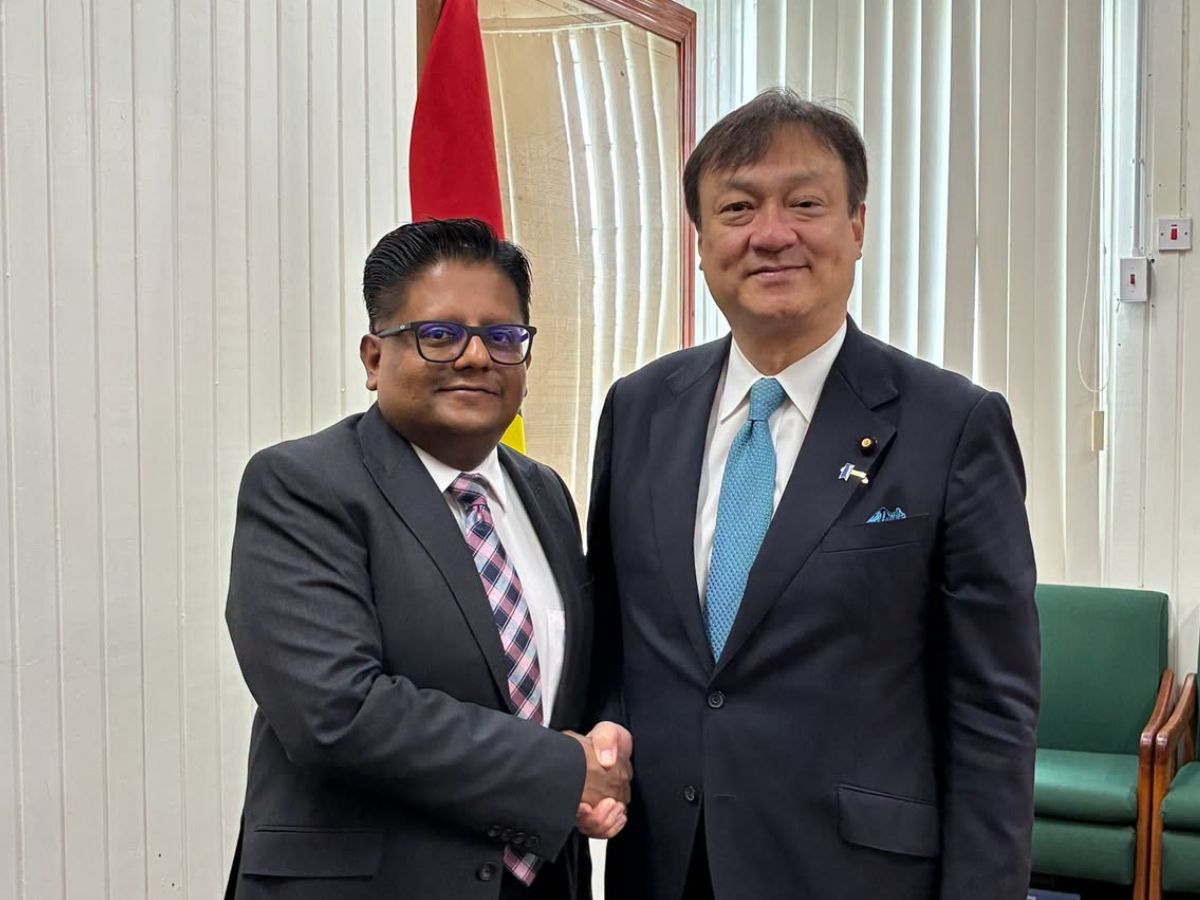
Guyana's Foreign Secretary, Robert Persaud, met on Wednesday with Japan's State Minister of Foreign Affairs, Iwao Horii, in Georgetown, as the two countries reaffirmed their commitment to strengthening bilateral relations. The talks, held at the Ministry of Foreign Affairs and International Co-operation on South Road, covered investment, climate change, technical co-operation and regional security.
Horii was accompanied by Japan's non-resident ambassador to Guyana, Akima Umezawa, along with other Japanese officials. The meeting formed part of a wider visit that also took in discussions with Guyana's Ministry of Finance.
During the talks, Horii praised Guyana's economic growth, noting that it has drawn increased Japanese investment, particularly in the oil and gas sector. He pointed to a rise in high-level exchanges between the two nations in recent years, attributing much of that momentum to Guyana's economic trajectory. Guyana has recorded some of the fastest growth rates of any economy in the world since production began at its offshore oil fields, and that expansion has drawn interest from investors across Asia, including Japan.
Persaud, for his part, described Japan as a consistent and reliable development partner. He highlighted Japanese support for projects in disaster management, energy, water and sanitation, framing the relationship as one built over decades rather than one driven solely by recent commercial opportunity. Among the initiatives cited was funding from the Japan International Cooperation Agency earlier this year for the construction of the Diamond Water Treatment Plant on the East Bank of Demerara, part of a concessional agreement signed in January to upgrade water infrastructure in the area.
Persaud said this kind of support complemented Guyana's own environmental priorities under its Low Carbon Development Strategy 2030, the government's long-term plan to diversify the economy while managing the environmental pressures of rapid oil-driven growth. Officials on both sides framed the water and energy projects as evidence that technical co-operation between the two countries extends well beyond the hydrocarbons sector that has dominated recent headlines.
Persaud also identified further opportunities for private-sector collaboration, saying there was scope to expand trade and investment beyond existing government-to-government frameworks. Guyanese officials have repeatedly stressed in recent months that they want to see more direct commercial engagement from Japanese companies, rather than co-operation channelled mainly through state institutions and development agencies.
Horii noted separately that Japan's technical co-operation efforts are expanding across the wider Caribbean Community, not just in Guyana. Japan has held a series of ministerial-level conferences with CARICOM states in recent years, and officials in Tokyo have signalled an interest in using Guyana's growth as something of an entry point for broader regional engagement.
The visit comes as Guyana and Japan prepare to mark the 60th anniversary of diplomatic relations between the two countries. Both sides indicated that the anniversary would serve as an occasion to draft a new long-term strategic vision for the partnership, one that officials suggested would go beyond the current focus on energy and infrastructure to address trade diversification and regional security more directly.
No specific date was given for when that strategic document might be finalised, though officials described the anniversary period as a natural moment to formalise priorities that have so far been discussed on a project-by-project basis.
The meeting followed a similar visit by Horii to Guyana's Ministry of Finance, where he met Senior Minister in the Office of the President with Responsibility for Finance, Ashni Singh, to discuss deepening commercial ties. Singh told the Japanese delegation that Guyana was keen to see more Japanese companies establish a presence in the country as its economy continues to expand across multiple sectors.
Wednesday's talks did not produce any new agreements, but both delegations characterised the exchange as a step toward a more structured long-term partnership ahead of the anniversary celebrations.