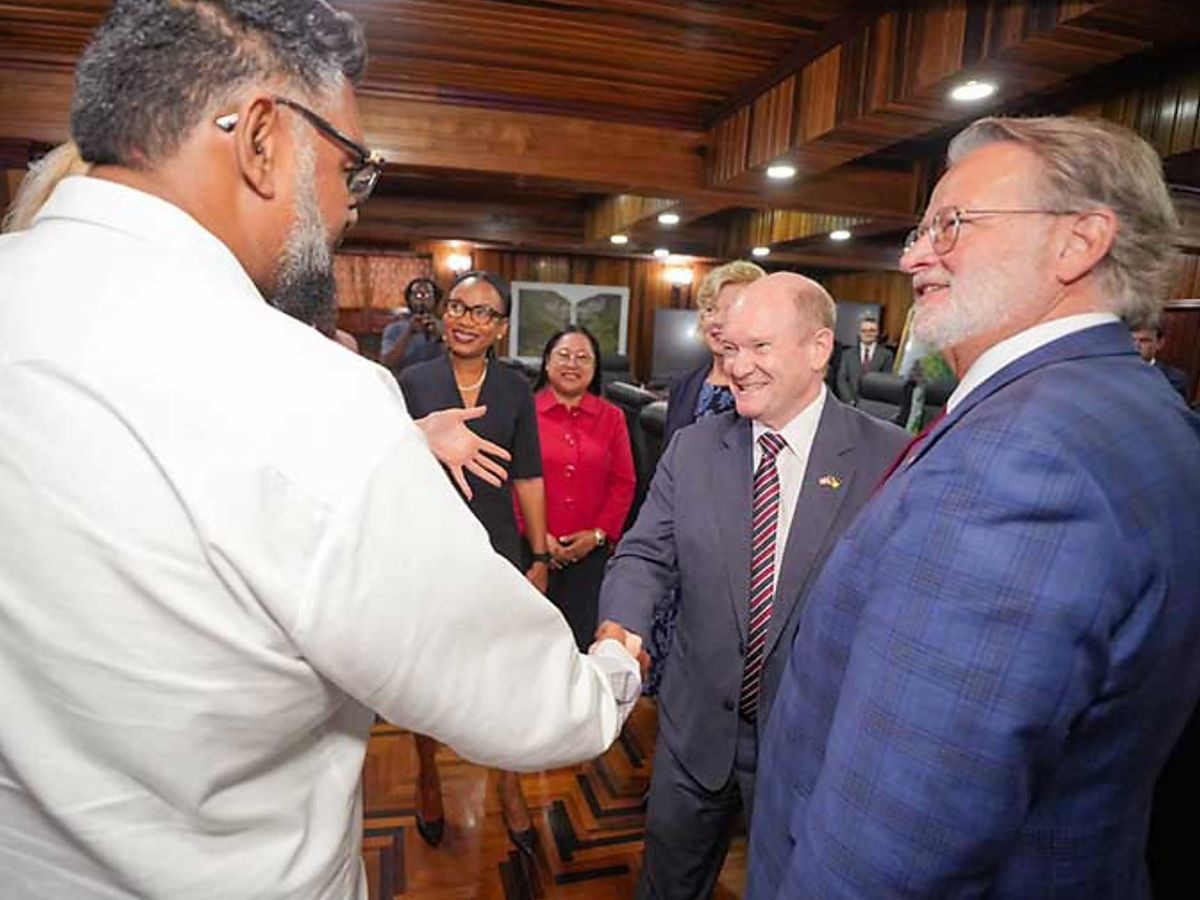
President Dr Irfaan Ali met a bipartisan delegation of United States lawmakers in Georgetown this week, in talks aimed at deepening ties between the two nations at a moment of heightened attention on the Western Hemisphere. The American delegation was led by Senator Christopher Coons, who has taken a prominent role in shaping US engagement with Guyana over recent years.
The discussions centred on regional stability, security cooperation and economic development, reflecting Washington's growing interest in a country that has become one of the fastest growing economies in the world following its offshore oil discoveries. For Georgetown, the visit offered a further opportunity to consolidate international backing at a time when the country continues to face a longstanding territorial dispute with Venezuela.
Security featured heavily in the talks. Officials from both sides addressed the threat posed by transnational organised crime, with particular attention paid to narcotics trafficking routes that pass through the Caribbean and South America. Guyana's location and its expanding economic weight have made it a more prominent player in regional security discussions than it was a decade ago, and the meeting produced commitments to strengthen cooperation between law enforcement and defence agencies in both countries.
Territorial sovereignty was also addressed directly. The American delegation reiterated support for Guyana's position in its dispute with Venezuela over the Essequibo region, an area rich in natural resources that Caracas has claimed for decades. The issue has taken on fresh urgency in recent years as tensions between Georgetown and Caracas have periodically flared, and Washington's continued backing is regarded in Guyana as an important diplomatic asset.
The visit fits within a broader pattern of American engagement across the Western Hemisphere, where competition for influence with other global powers has sharpened. Guyana's oil wealth, combined with its strategic position on the northern edge of South America, has elevated its standing in Washington's regional calculations. Officials on both sides described the relationship as one that has grown substantially in recent years, moving from a peripheral diplomatic connection to one treated with considerably more weight.
President Ali used the meeting to outline the progress his government has made since taking office in 2020. He pointed to sustained investment in infrastructure, describing new roads, bridges and housing developments that have accompanied the country's rapid economic expansion. He also discussed efforts to strengthen energy and food security, areas that Guyana has prioritised as it seeks to reduce reliance on imports and build capacity that can support long term growth.
Public services featured prominently in the president's remarks. He described expanded investment in healthcare facilities and staffing, along with efforts to modernise the education system, which the government has identified as central to preparing the workforce for an economy transformed by oil revenues. Agricultural development was raised as well, with Ali highlighting programmes intended to boost productivity and support rural communities that have not always benefited directly from the oil sector's growth.
Thursday's meeting was not an isolated event. It forms part of a continuing sequence of high level exchanges between Washington and Georgetown that has intensified over the past two years, including visits by senior American officials and reciprocal engagements involving Guyanese ministers. This pattern suggests a relationship that both governments intend to sustain rather than treat as a one off diplomatic gesture.
The broader significance of the meeting lies in what it suggests about the shifting balance of influence in South America and the Caribbean. As Guyana's economic and strategic importance continues to grow, its relationship with Washington appears set to expand further, with implications for how regional security and territorial disputes are managed in the years ahead. For a country still adjusting to the scale of its recent transformation, the continued attention from Washington represents both an opportunity and a responsibility as it navigates its place in a changing regional order.

.jpg)