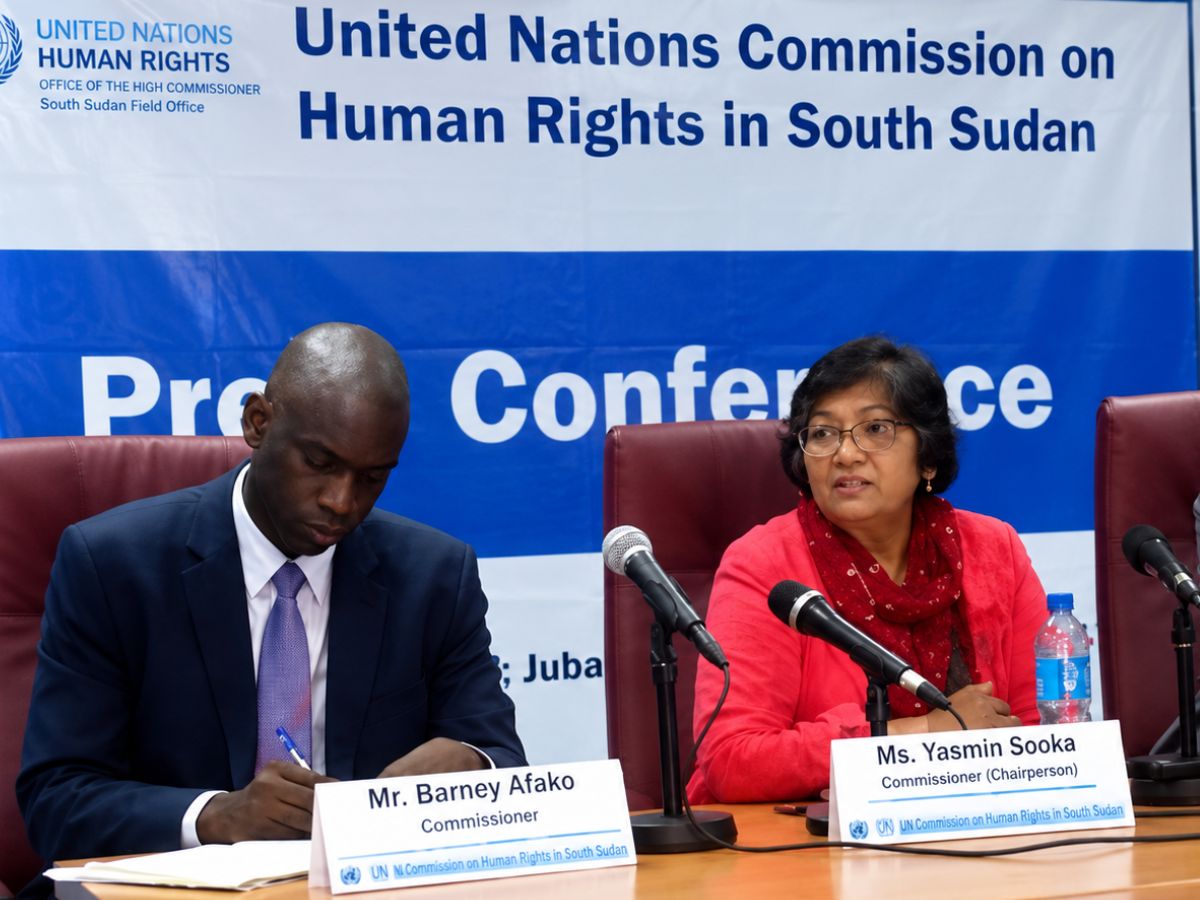
South Sudan's fragile move towards its first national elections is being jeopardised by a resurgence of localised violence, deepening political friction and a narrowing of civic space, according to the United Nations Commission on Human Rights in South Sudan. The warning followed the Commission's fourteenth visit to the country in a decade, a four-day mission during which investigators met government officials, security and political figures, civil society representatives and survivors of recent fighting. Chairperson Yasmin Sooka said the patterns of harm they encountered had changed little over the years, even as the human cost kept rising.
The clearest illustration of that cost came in Jonglei state, where Sooka travelled to meet people affected by recent fighting in the northern part of the region. Survivors, including women and girls, described sexual violence, killings, displacement and forced separation from family members. Several said they had been left without access to medical or psychosocial care despite urgent health needs. The Commission noted that these accounts were not isolated incidents but part of a recurring cycle, one in which the same abuses resurface in different districts with little sign of prevention or redress.
That cycle is unfolding against a security and humanitarian backdrop that has grown markedly worse this year. The Commission voiced particular alarm over an attack on a UNMISS patrol in Jonglei that killed two peacekeepers and wounded others, calling for a prompt and independent investigation. Humanitarian workers have fared little better. According to the UN, at least 36 aid workers and contractors have been killed in South Sudan since January, already surpassing the total for the whole of 2025, while more than 450 incidents of violence against humanitarian personnel and assets were recorded between January and July. This is happening at a moment when roughly ten million people, close to two thirds of the population, are expected to need humanitarian assistance, even as funding for the response remains severely short.
The Commission's visit came at what it described as a pivotal moment. South Sudan is due to hold its first national elections since gaining independence in 2011, currently scheduled for December. Investigators were careful to frame the right to vote as fundamental, but they cautioned that elections held without proper safeguards could do more harm than good. In an advisory published in August, the Commission warned that a vote lacking fair competition, credible dispute resolution and genuine political inclusion could act as a trigger for wider violence rather than a step beyond it. Commissioner Barney Afako said that implementation of the 2018 Revitalised Agreement had stalled, yet remained essential to any credible transition. The Commission repeated its call for inclusive dialogue that reaches beyond the main political parties to civil society, women and young people, arguing that confidence in the process matters as much as the mechanics of the vote itself.
Underlying all of this, investigators pointed to institutional failures that have proved difficult to shift. Previous Commission reporting has linked the diversion of public revenue, including from oil, to preventable deaths, malnutrition and exclusion from education, describing a state whose resources are being siphoned away from the basic protections citizens are owed. That financial drain compounds a justice system investigators regard as chronically weak. Few of those responsible for killings, sexual violence or attacks on civilians face prosecution, and the institutions meant to hold them to account remain under-resourced and, in some cases, subject to political interference. The Commission's conclusion was blunt: without a serious effort to address corruption and impunity together, the abuses documented in Jonglei and elsewhere are likely to recur, regardless of what happens at the ballot box in December.

.jpg)