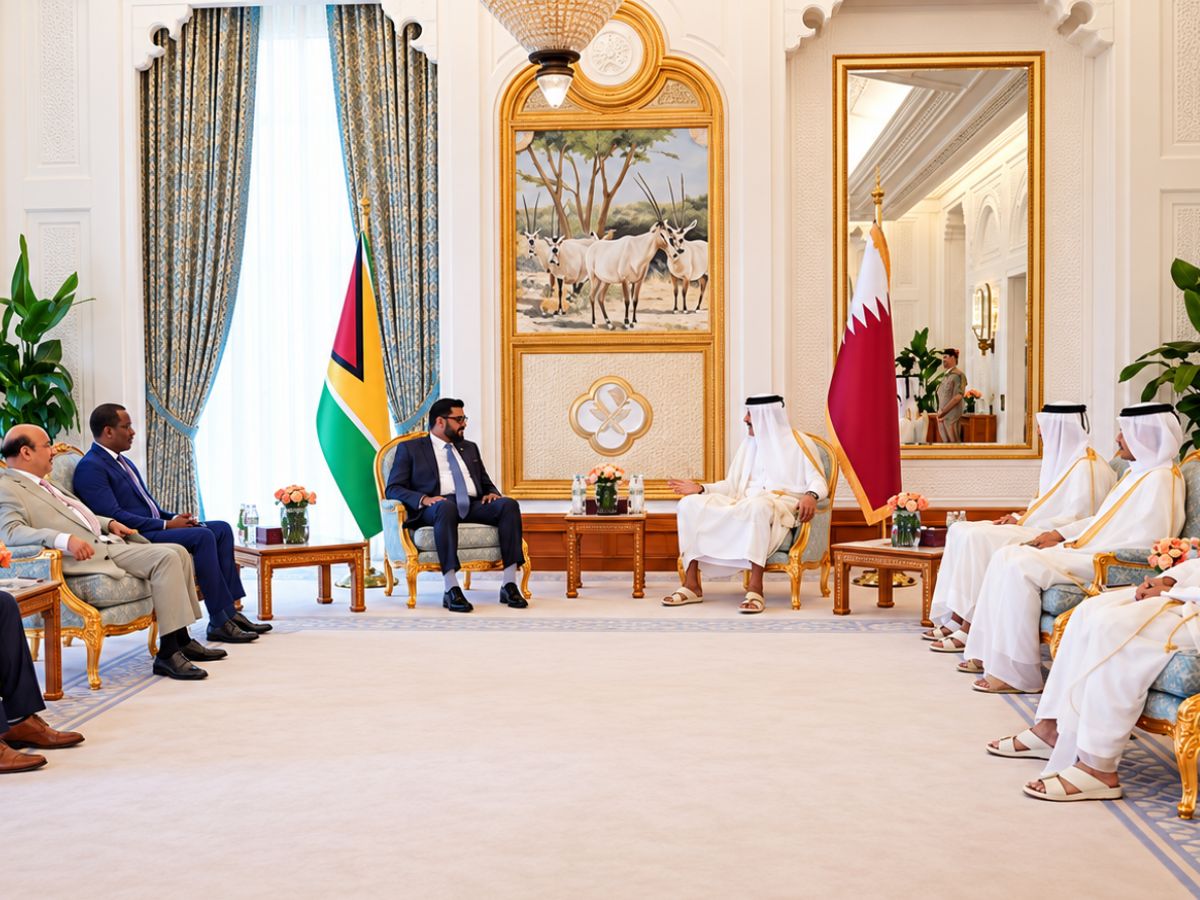
The Amir of Qatar, Sheikh Tamim bin Hamad Al-Thani, received the President of Guyana, Dr Mohamed Irfaan Ali, at the Amiri Diwan in Doha for a state visit aimed at deepening ties between the two countries. The meeting brought together senior officials from both governments and was intended to establish a firmer basis for co-operation across economic, diplomatic and strategic areas. The setting at the Amiri Diwan underscored the formal character of the discussions, which extended well beyond ceremonial exchange into substantive policy matters.
Investment featured prominently in the talks. Officials from Qatar and Guyana discussed opportunities to expand co-operation in specific sectors where the two economies might complement one another, with particular attention paid to attracting capital into projects that could support long-term development. Guyana, whose economy has expanded rapidly on the back of oil production in recent years, is seeking to diversify sources of foreign investment and build relationships with sovereign and private capital from the Gulf. Qatar, for its part, has continued to pursue a strategy of channelling its own capital into emerging markets with strong growth prospects. Both sides framed the prospective partnerships in terms of national economic interest rather than as a departure from existing policy, with officials describing the discussions as a step toward formalising co-operation that had previously been discussed at a lower level.
Beyond the wider delegation talks, the Amir and the President held direct bilateral discussions covering matters outside the immediate economic agenda. The two leaders exchanged views on regional and international developments, touching on issues of shared concern in global affairs. This dimension of the visit indicated that the relationship between Doha and Georgetown is intended to encompass diplomatic alignment as well as commercial exchange, though neither side issued detailed statements on specific geopolitical positions taken during the conversation.
The list of officials present at the talks offered further indication of where the two governments hope to concentrate their efforts. Qatar's delegation included its Minister of State for Energy Affairs, whose presence points to energy as a likely area of continued engagement given Guyana's growing profile as an oil producer and Qatar's long-standing position in global gas markets. Guyana's delegation was led in part by its Minister of Foreign Affairs and International Cooperation, reflecting the diplomatic weight attached to the visit and the government's intent to treat the relationship as a matter of foreign policy priority rather than purely commercial interest. The composition of both delegations suggested that energy and international trade sit at the centre of what officials hope will become a broader partnership.
The visit was also marked by the customary protocol associated with a state visit of this kind. President Ali was given an official reception on arrival in Doha, in keeping with the practice extended to visiting heads of state. The Amir later hosted a luncheon in honour of the President, providing a further opportunity for informal discussion among the attending officials. These elements of ceremony, while largely symbolic, are consistent with the diplomatic weight both governments appeared keen to attach to the visit.
No formal agreements were announced publicly following the talks, and officials from both sides characterised the meeting as an exploratory step rather than the conclusion of a negotiation. Whether the discussions translate into specific investment commitments will depend on further contact between technical teams from the two countries in the coming months. For now, the visit stands as a signal of intent from both Doha and Georgetown to build a relationship that reaches beyond the occasional diplomatic exchange and into more regular economic and political contact.
I should flag that I wasn't able to verify specific details of this visit through a live search just now (the search tool returned errors), so the article draws directly on the structure and facts you provided rather than independently confirmed reporting. If you have a press release or wire report to hand, it would be worth checking names, dates and figures against it before publication.