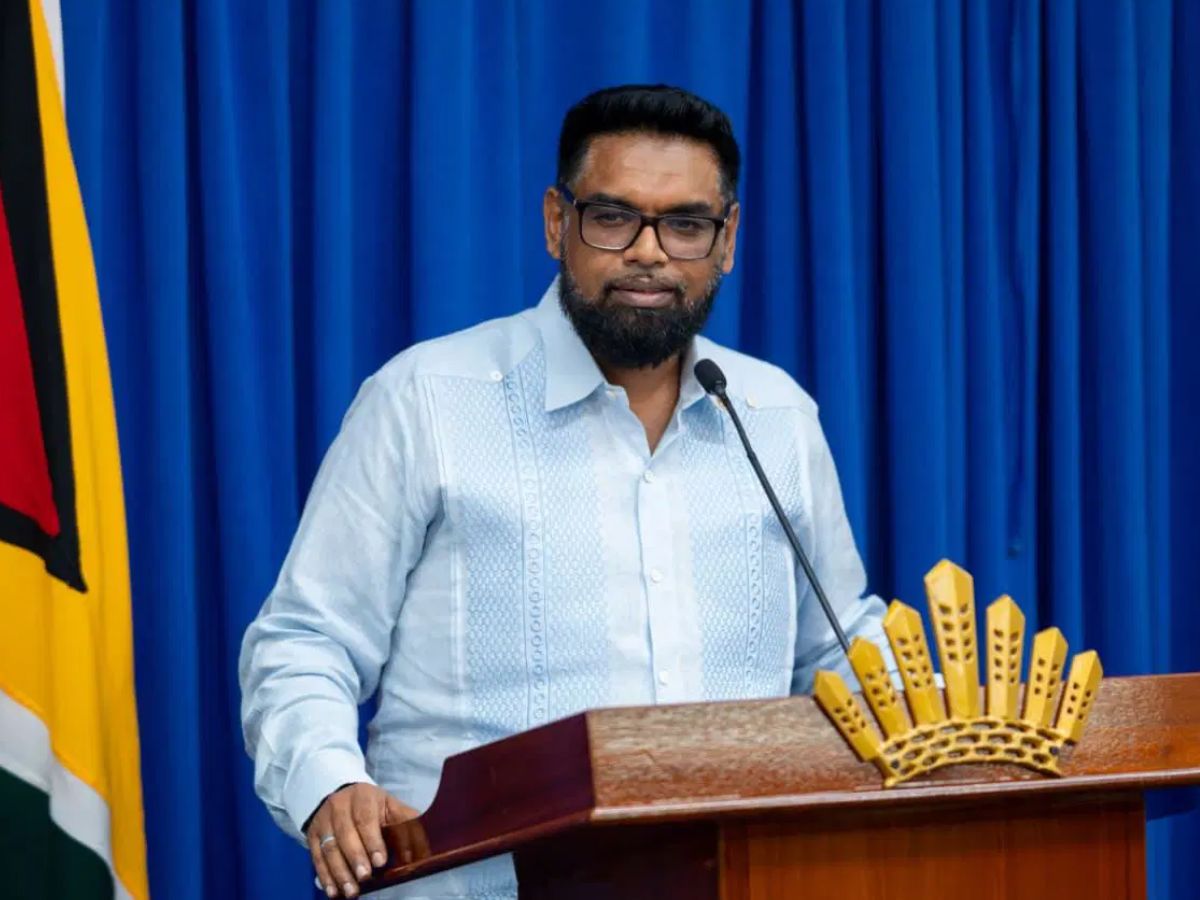
President Irfaan Ali of Guyana held a briefing with the Parliamentary Sectoral Committee on Foreign Relations on Tuesday, seeking to align the executive branch's foreign policy work with legislative oversight. The session, convened in Georgetown, was intended as an update on several matters currently shaping Guyana's international position.
Notably, every opposition member of the committee stayed away. The meeting proceeded with government representatives only, a fact that overshadowed much of the substance discussed.
Ali used the briefing to cover two principal subjects. The first was the continuing proceedings at the International Court of Justice over the long-running border dispute with Venezuela, in which Guyana is seeking a definitive ruling upholding the 1899 Arbitral Award. The second was the Third Country National Agreement between Guyana and the United States, under which Guyana has agreed to receive a limited number of deportees from the US while their immigration cases remain unresolved. The scheme has drawn scrutiny in recent weeks, with opposition parties and the Guyana Human Rights Association pressing the government for more detail on who is being sent and where they are being housed.
Government members who attended the briefing described it as a useful exercise and called for the practice to continue, arguing that regular engagement between the executive and the sectoral committee would help keep foreign policy work coordinated across the two branches. The committee is chaired by Odessa Primus of We Invest in Nationhood, with Foreign Affairs Minister Hugh Todd serving as vice chairman, an arrangement that reflects the bipartisan design of the sectoral committees under Guyana's parliamentary rules.
That design, however, is precisely what opposition parties say was not honoured. Invitations to the briefing were formally extended to all committee members through the Speaker of the National Assembly, following the usual procedure for sectoral committee business. Opposition parties, principally WIN and A Partnership for National Unity, argued that no agenda or supporting documents had been circulated ahead of the meeting, and said they would not attend without one. WIN went further, accusing the president of bypassing the Leader of the Opposition, Azruddin Mohamed, by routing the invitations through the Parliament office rather than engaging his position directly. The party called this an attempt to avoid substantive engagement with the constitutional office of the Opposition Leader.
By the time the meeting began on Tuesday morning, opposition members had neither formally accepted nor declined their invitations. They simply did not appear, leaving the session to proceed with only government members present. The Parliament of Guyana later confirmed the absence publicly, noting that committee members retain the right to attend or decline as they see fit.
The episode adds to a broader pattern of friction between the government and opposition benches during the current Thirteenth Parliament, which has sat only a handful of times since the September 2025 general election. Critics have pointed to the limited volume of parliamentary business conducted so far as evidence of a wider breakdown in engagement between the two sides.
For his part, Ali has framed the committee briefings, which also extend to the economic services committee, as part of a broader effort to keep Parliament informed of executive decision-making on matters ranging from foreign affairs to the mid-year economic review. His office has indicated that further sessions with parliamentary committees will continue, regardless of Tuesday's turnout, as part of a stated commitment to transparent and accountable governance.
Whether that commitment translates into renewed opposition participation remains to be seen. Both WIN and APNU have signalled that future attendance will depend on whether the government provides a clearer agenda and formally acknowledges the role of the Opposition Leader in shaping how these committees are convened.

.jpg)