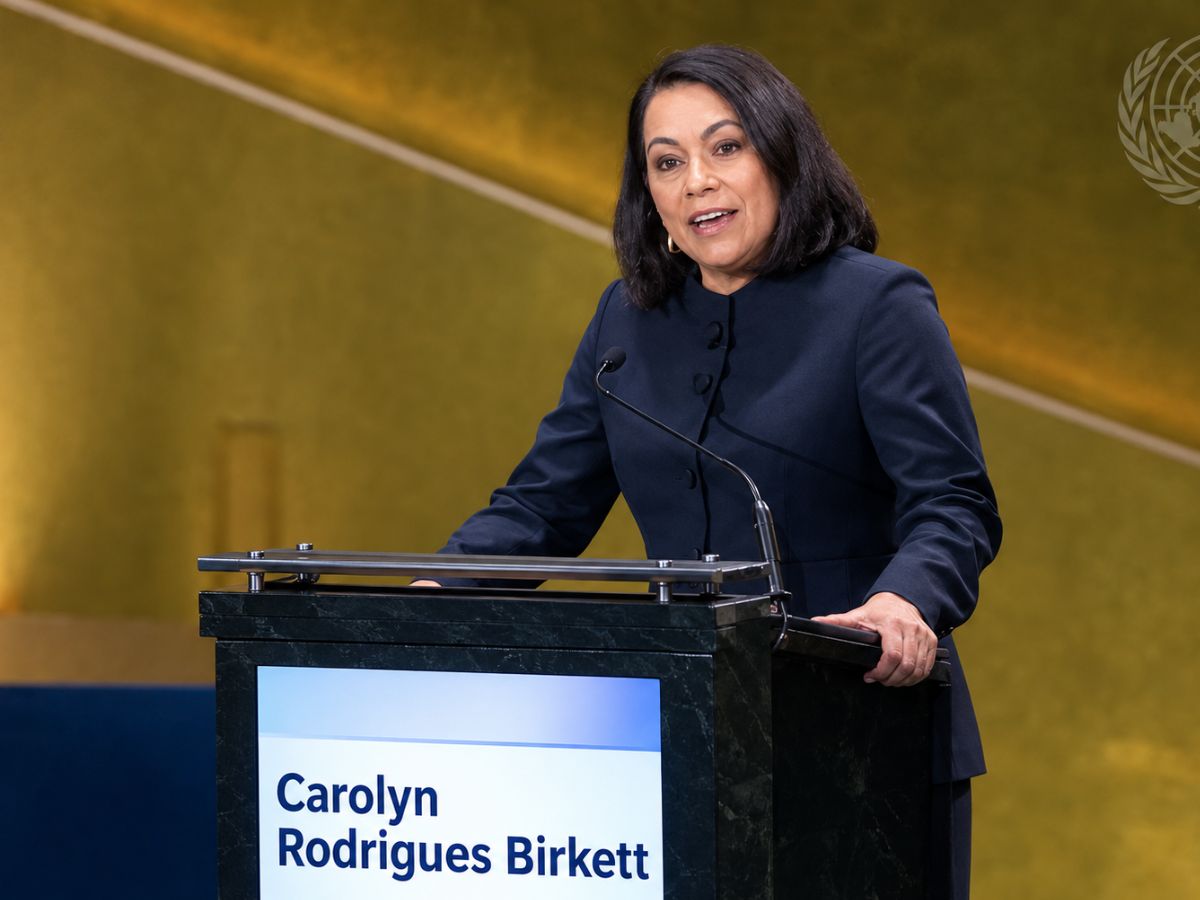
Carolyn Rodrigues-Birkett, Guyana's Permanent Representative to the United Nations, is formally in the running to succeed António Guterres as Secretary-General. Guyana submitted her nomination in June 2026, and if selected by the Security Council and appointed by the General Assembly, she would become the first woman to lead the organisation in its 80-year history. Her candidacy also carries separate historical weight. If chosen, she would become the first person of Indigenous descent and the first Caribbean national to lead the United Nations.
The campaign has drawn firm institutional backing. Guyana's president announced her nomination in June 2026, and the Caribbean Community moved quickly to consolidate support. At their July summit, CARICOM heads of government stated that they "strongly welcomed Guyana's nomination of Ambassador Carolyn Rodrigues-Birkett and expressed their full endorsement for her candidacy." The gesture was notable given the range of candidates from the wider region. Regional leaders noted that while several high-calibre candidates had emerged from the wider Latin American and Caribbean group, Rodrigues-Birkett possessed the administrative balance and diplomatic versatility needed to restore global trust. Support has continued to arrive from individual member states. In Jamaica, the Speaker of the House of Representatives, Juliet Holness, publicly voiced support for the bid, a gesture Rodrigues-Birkett described on social media as humbling.
Two arguments run through her campaign. The first concerns gender. Nine men have held the post of Secretary-General since the organisation's founding, and Rodrigues-Birkett has argued that this record no longer reflects the world the UN claims to represent. At a General Assembly dialogue in June, she spoke of the qualities the next Secretary-General must possess, describing a leader who must act as administrator, peacemaker and negotiator all at once. The second argument concerns geography. The UN has long operated an informal system of regional rotation for the top job, and Rodrigues-Birkett's supporters contend that this election represents a narrowing opportunity for Latin America and the Caribbean. Should a candidate from elsewhere secure consecutive terms, they argue, a Caribbean Secretary-General could be delayed by decades. The Caribbean, despite its long record of multilateral engagement, has never produced a Secretary-General, a point her campaign has made repeatedly in outreach to smaller states.
Her standing in the race can be measured through the Security Council's confidential straw polls. In the first round, held on 30 July, Rebeca Grynspan of Costa Rica led with 10 "encourage" votes, one discourage vote and four no-opinions, while Rodrigues-Birkett followed with nine encourages, two discourages and four no opinions. A second round in August produced a shift. Rodrigues-Birkett received eight encourage votes, one fewer than in the first round, against three discourage and four no-opinion responses, placing her narrowly ahead of Grynspan, who fell to seven encourages. These informal polls do not bind the Council but shape the consensus that eventually produces its formal recommendation to the General Assembly, which has historically ratified the Council's choice without amendment.
Rodrigues-Birkett brings a lengthy record in Guyanese government to the contest. She has served as her country's minister of foreign affairs and, earlier, as minister of Amerindian affairs, before becoming ambassador to the UN in 2020. Her experience representing Guyana on the Security Council during 2024 and 2025, including through debates on the war in Gaza, is often cited by diplomats as a distinguishing feature of her candidacy. Her platform centres on making the UN more agile and pragmatic, with particular emphasis on reforming its response to climate change, technological disruption and the proliferation of armed conflict.
She is not alone in the field. Other declared candidates include Michelle Bachelet of Chile, Rebeca Grynspan of Costa Rica, María Fernanda Espinosa of Ecuador, Rafael Grossi of Argentina and Macky Sall of Senegal, among others. The process is expected to continue through further rounds of Security Council polling in the coming weeks. Guterres' second term ends on 31 December 2026, and whoever the Council recommends will require confirmation by a vote of the General Assembly before taking office in January 2027.