Guyana has marked sixty years of membership in the United Nations with a national statement reaffirming its commitment to multilateralism, international law and the peaceful settlement of disputes between states.
The declaration, issued this week, coincides with the anniversary of the country's admission to the UN on 20 September 1966, when it was accepted during the twenty-first session of the General Assembly, months after gaining independence from Britain. The statement restates Guyana's faith in sovereign equality among nations and in the UN Charter as the framework governing relations between states, language that officials in Georgetown have used consistently since independence.
Much of the anniversary statement looks backward. Guyana's diplomatic record at the UN began during the decolonisation era, when the country took an active role in anti-colonial movements across Africa and Asia. It later served on the UN Council for Namibia, contributing to the international effort against South African apartheid rule in the territory. That period established a pattern that has held for six decades: a small state using UN forums to press positions that larger powers might otherwise set aside.
Guyana has since built a record of institutional participation that is unusual for a country of fewer than a million people. It has held the presidency of the General Assembly, sat as a non-permanent member of the Security Council, and served on the Economic and Social Council. It has chaired the Group of 77 and China twice, a bloc that speaks for the majority of the UN's developing-country membership on economic questions. Guyanese officials and jurists have also sat on the International Court of Justice and on UN human rights committees, giving the country a presence in the organisation's legal and rights machinery well beyond what its size would suggest.
That advocacy has tended to cluster around a few recurring themes. Guyana has pushed consistently for economic equity between developed and developing states, for non-intervention in the internal affairs of sovereign nations, and for progress on nuclear disarmament. These are not new positions for Georgetown, but the anniversary statement presents them as evidence of a durable foreign policy rather than a shifting one.
The statement's more forward-looking element concerns climate policy. Guyana has positioned itself in recent years as a vocal participant in international climate negotiations, arguing for the interests of low-lying and forested developing states in discussions over emissions, finance and adaptation. The government frames this as a continuation of its longstanding advocacy for smaller nations rather than a departure from it.
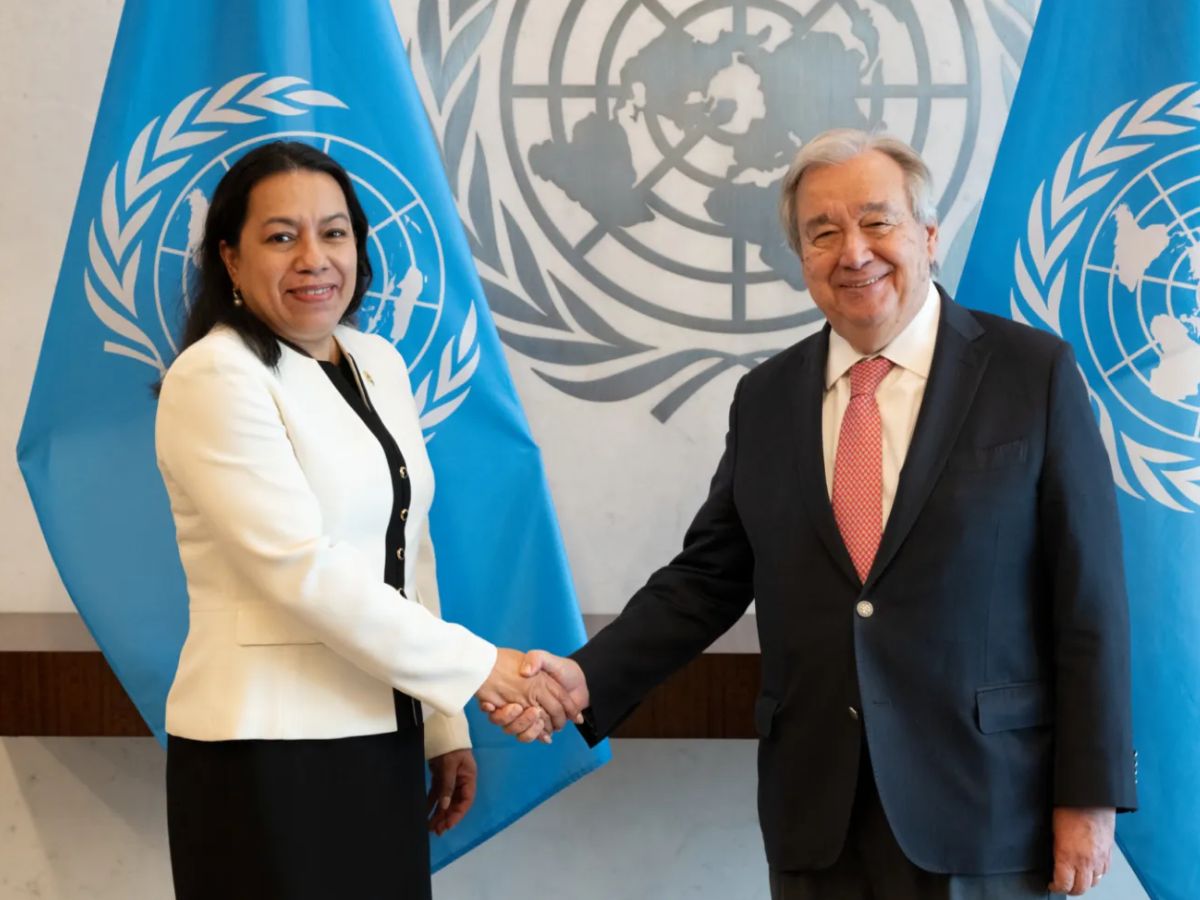
The anniversary statement also confirms Guyana's nomination of Ambassador Carolyn Rodrigues-Birkett for the post of UN Secretary-General. Rodrigues-Birkett has held senior positions in Guyanese government and diplomacy, including as a former foreign minister. Officials in Georgetown have presented her candidacy as proof that a small state can produce leadership capable of running the organisation, a claim that will be tested as the selection process for the next Secretary-General unfolds among UN member states in the coming period.
Finally, the statement expresses appreciation for the UN Country Team and other UN agencies operating in Guyana, crediting them with supporting national development programmes, peacebuilding efforts and the strengthening of democratic institutions domestically. This element reflects the practical, day-to-day relationship between Guyana and the UN system, distinct from the more symbolic themes of the anniversary statement.
Taken together, the statement functions as both retrospective and pitch. It recounts a diplomatic history stretching from the anti-apartheid struggle to the current climate agenda, and it uses that history to support a case for continued, and in the case of the Secretary-General nomination, expanded Guyanese influence within the UN system. Whether that case gains traction will depend on decisions made in New York over the months ahead, but the anniversary itself marks an uncontested fact: six decades of continuous membership in the organisation Guyana joined the year it became independent.