
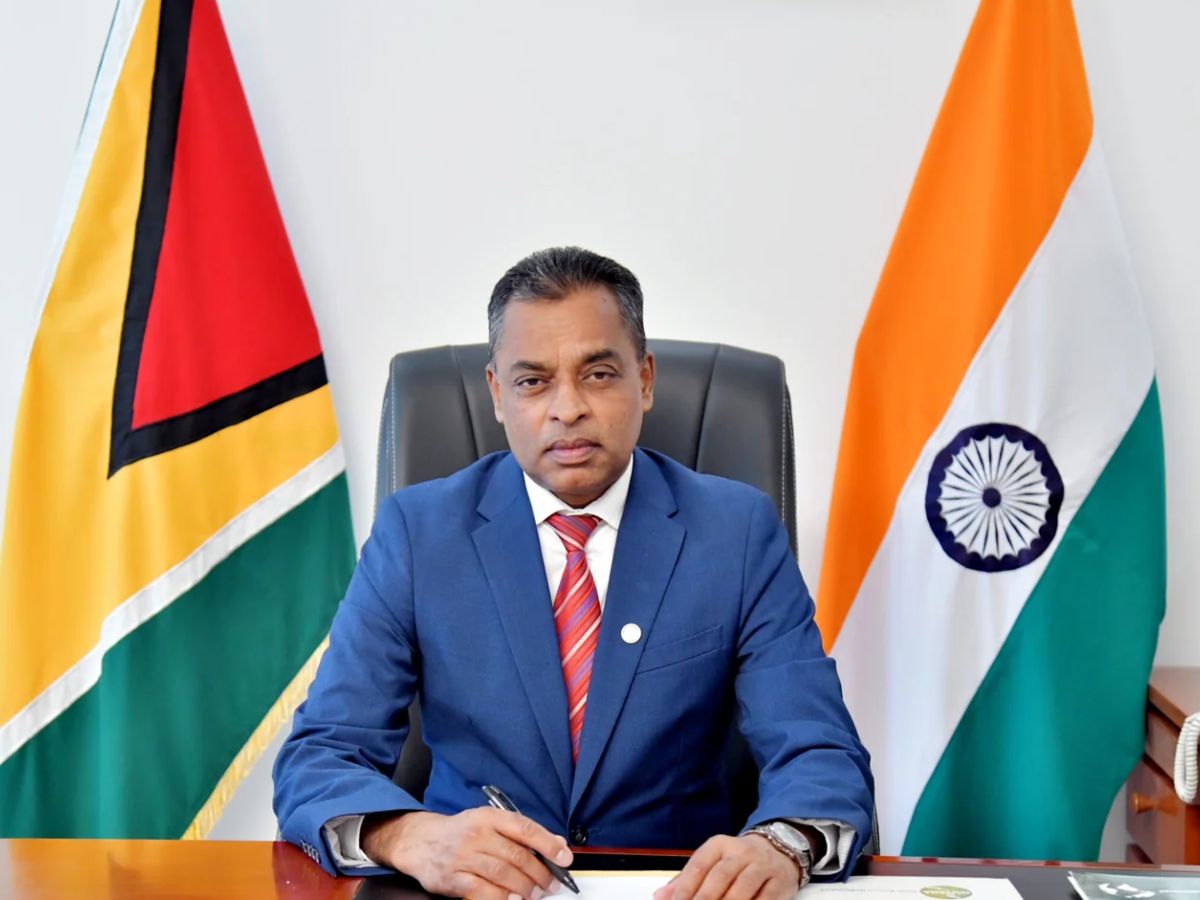
Guyana has emerged as one of the fastest growing economies in the world, a transformation driven almost entirely by offshore oil discoveries made over the past decade. The scale of that growth has forced the government in Georgetown to think carefully about how the country manages its new wealth, and increasingly that thinking involves New Delhi.
Dharamkumar Seeraj, Guyana's High Commissioner to India, has been outlining why he believes India will play a significant role in his country's development plans over the coming years. In a recent conversation, he described a relationship that extends well beyond ceremonial diplomacy into practical cooperation across several sectors.
Energy remains the obvious starting point. Guyana's oil output has climbed sharply since production began in 2019, and the government is keen to attract investment that can support both the extraction sector and the infrastructure needed to manage it responsibly. Seeraj pointed to opportunities for Indian companies in this space, but he was equally keen to stress that Guyana does not want its growth defined solely by hydrocarbons. The country's Low Carbon Development Strategy, first introduced in 2009 and updated since, sets out an approach that pairs oil revenue with investment in forestry protection and renewable energy. Indian expertise in solar and wind development, Seeraj suggested, could help Guyana diversify its energy mix even as oil remains the dominant source of state revenue for the foreseeable future.
Health and agriculture form the second strand of the relationship. Guyana's population is small, just over 800,000 people, and its domestic capacity in areas such as pharmaceutical production and medical training is limited. Seeraj said India's experience in generic drug manufacturing and healthcare delivery at scale offers a model that Guyana could adapt to its own circumstances. Agriculture carries a similar logic. Guyana has long supplied rice and sugar to Caribbean markets, but officials want to broaden the range of crops grown domestically and improve yields, partly as insurance against food security pressures that affect small import-dependent economies. Indian agricultural research institutions, with decades of experience in tropical farming techniques, were cited as a natural partner for this work.
The third area concerns digital governance. As oil revenue flows into government coffers, Guyana faces the familiar challenge of building administrative systems capable of managing that money transparently and efficiently. Seeraj referenced India's Aadhaar identification system and its broader digital public infrastructure as examples of the kind of technology transfer that could help Guyana modernise its own institutions, from tax collection to public service delivery.
Beyond the sector-specific detail, Seeraj framed the relationship in wider terms. Both countries are democracies, he noted, and both have positioned themselves as advocates for developing nations navigating a global economy still shaped by older powers. He argued that Guyana and India share an interest in reforming international trade rules, particularly where they affect smaller economies, and in ensuring that sustainable development commitments made by wealthier nations are actually honoured.
This framing places Guyana's outreach to India within a longer pattern of small states seeking partners who can offer both practical assistance and diplomatic weight. Guyana has fewer than a million citizens but sits on oil reserves that have drawn attention from major powers, including a long-running border dispute with Venezuela that has occasionally escalated into military posturing. Seeraj did not dwell on the dispute at length, though he acknowledged that Guyana's international partnerships, India included, matter partly because they signal broader diplomatic support.
Whether the relationship develops into substantial Indian investment remains to be seen. Memoranda of understanding and diplomatic goodwill are not the same as capital deployed, and Guyana's small domestic market limits the scale of what any single sector partnership can achieve. Still, Seeraj's comments suggest that Georgetown views India as one of the more significant relationships it intends to cultivate as it works out how to spend, and safeguard, its oil wealth over the next generation.

.jpg)
.jpg)
.jpg)
.jpg)