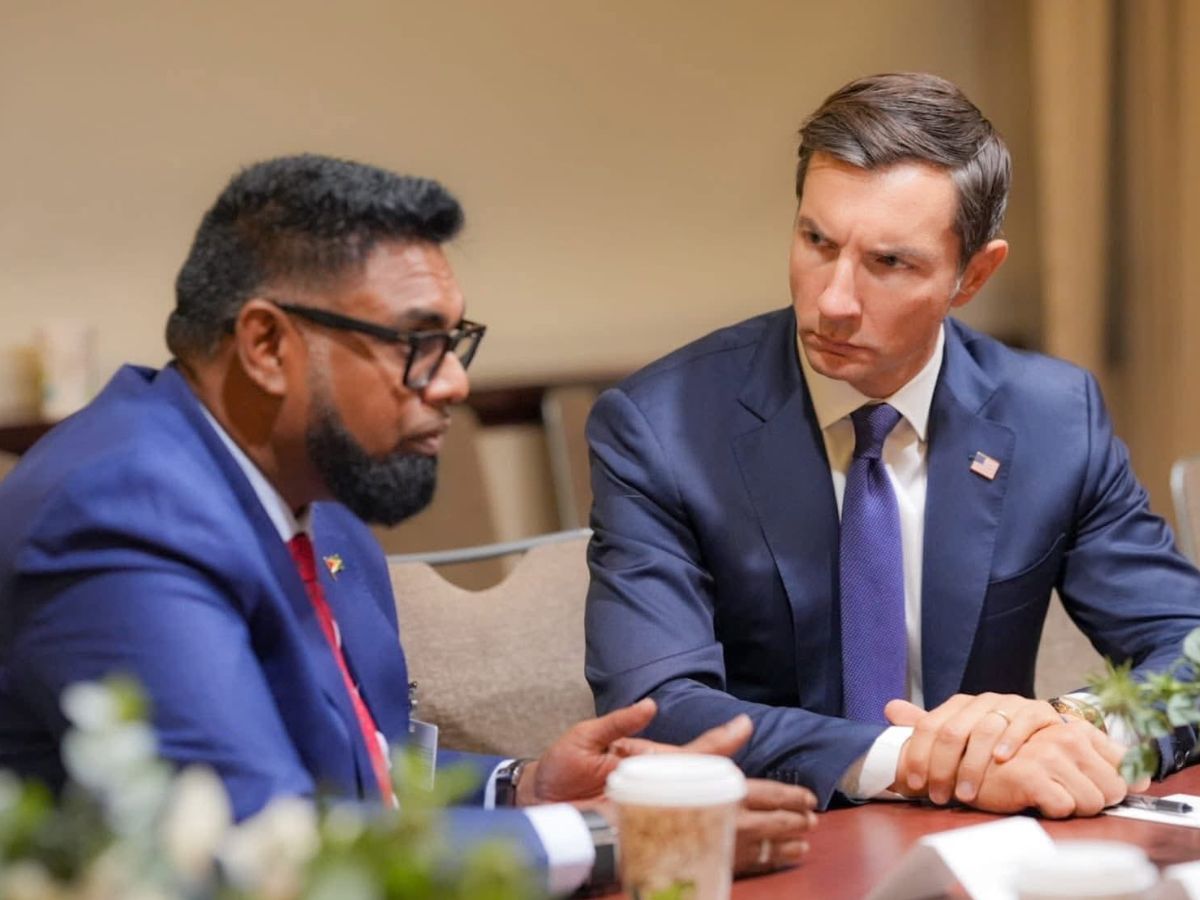
Guyana's President Irfaan Ali met with the Chairman of the US Export-Import Bank, John Jovanovic, on the sidelines of the United Nations General Assembly in New York this week. The talks produced a commitment from the American export credit agency to widen its financial support for Guyana well beyond the energy sector projects that have so far defined the relationship. Officials from both sides confirmed that housing, port infrastructure and aviation now feature in the bank's expanding portfolio of Guyanese initiatives.
The Export-Import Bank, known as EXIM, is the official export credit agency of the United States federal government. Its loans carry the backing of the full faith and credit of the US government, a distinction that has made its financing attractive to smaller economies seeking large-scale infrastructure funding without turning to commercial lenders.
EXIM's relationship with Guyana centres on the Wales Gas-to-Energy project on the West Bank Demerara, where the bank approved more than $527 million in financing in December 2024. That sum is funding construction of a natural gas separation plant, a 300 megawatt combined cycle power plant and associated pipeline works, undertaken by the Houston-based contractor Lindsayca. Once operational, the plant is expected to double Guyana's installed electricity capacity. Construction has continued through 2026, with Jovanovic visiting Georgetown in April to review progress alongside President Ali and contractor staff.
The New York meeting has now opened discussion on a second phase at Wales, an identical 300 megawatt facility that would sit adjacent to the first. No financing figure has yet been disclosed for this second plant, and officials described the arrangement as an agreement in principle rather than a signed commitment. Guyanese authorities have separately floated the possibility of EXIM support for the long-delayed Amaila Falls hydropower scheme, though this remains at an earlier and less defined stage than the Wales expansion.
Beyond power generation, the bank's growing interest in Guyana's transport sector has become more concrete. During his April visit, Jovanovic issued a letter of interest covering the proposed deepwater port at Berbice, a project the government has pursued for several years as part of its ambition to establish Guyana as a regional logistics hub. The Berbice project has attracted a mix of public and private capital, including a separate joint venture port announced by two local firms, and EXIM's involvement would place it among a consortium of financiers rather than a sole backer. Aviation has entered the conversation more tentatively, with early discussions covering possible funding for upgrades to Lethem Airport near the Brazilian border, though this has not progressed to a formal proposal.
On the social infrastructure side, EXIM financing is now being extended toward affordable housing projects, a departure from the bank's traditional focus on large industrial and energy exports. Guyanese officials have framed this as recognition that the country's oil-fuelled growth requires parallel investment in housing stock for a rapidly expanding workforce.
The broadening of EXIM's role in Guyana follows a series of engagements stretching back to September 2025, when Ali and Jovanovic first met on the margins of the UN General Assembly. Since then, EXIM delegations have visited Georgetown chambers of commerce and project sites, and in May the two countries signed a wider financing agreement reported to be worth around $2 billion, covering government projects across several sectors. Guyana has historically drawn concessional financing from India, China and, more recently, the Islamic Development Bank, and officials in Georgetown have described the American engagement as a signal to the wider Caribbean region of Washington's renewed interest in financing regional development.
EXIM's own authorisation is due to expire at the end of 2026, and its reauthorisation by Congress remains under discussion. Officials have not said how that legislative process might affect the timeline for the projects discussed in New York this week, including the second Wales plant and the Berbice port financing.