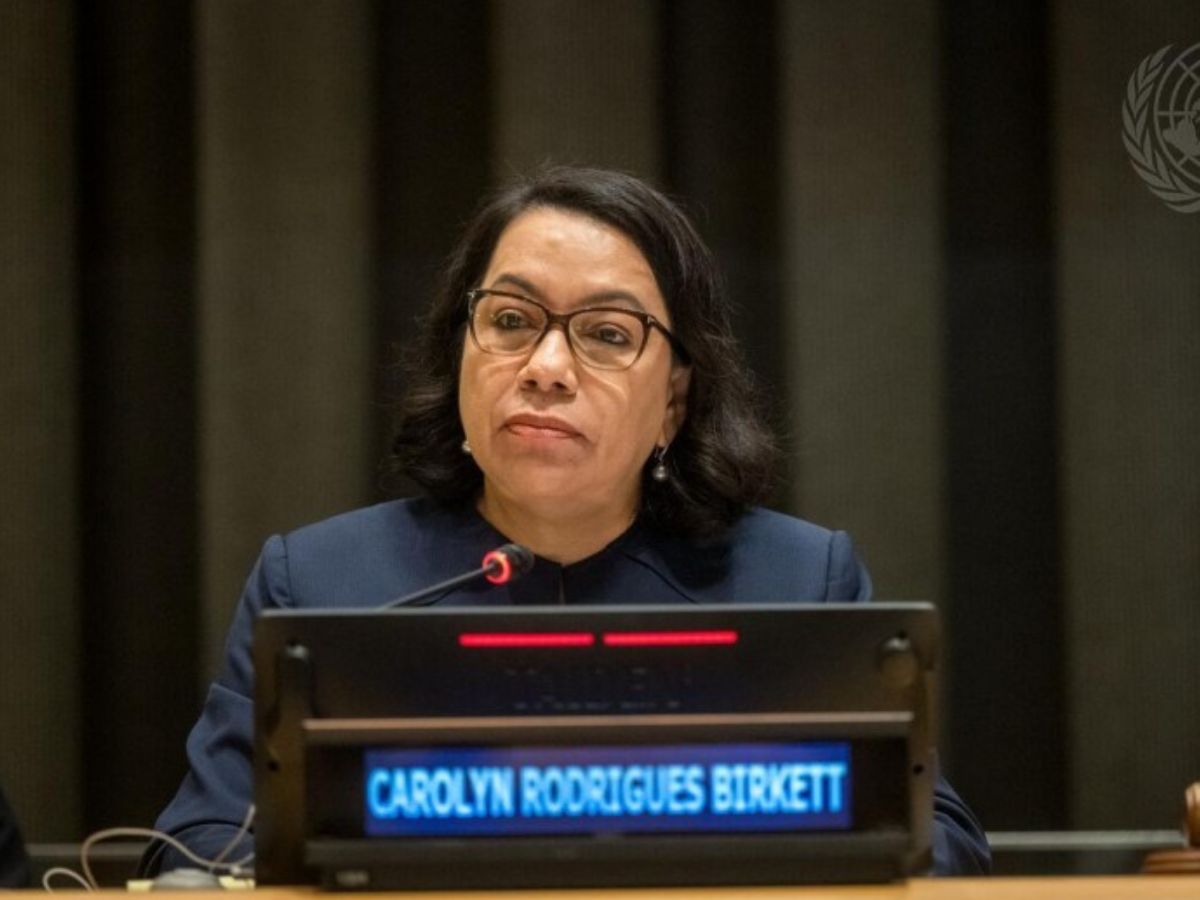
Guyana's Permanent Representative to the United Nations, Ambassador Carolyn Rodrigues-Birkett, has set out her position on the role of civil society organisations within UN decision-making, telling delegates she intends to preserve and strengthen existing channels for non-governmental input should she be appointed Secretary-General.
The statement came during an interactive dialogue with member states, a session held shortly after President Dr Irfaan Ali confirmed Guyana's formal nomination of the Ambassador for the UN's top post.
Much of the questioning from delegates centred on a specific tension: how a future Secretary-General might move NGOs beyond their current consultative function towards something closer to genuine strategic partnership in UN affairs. It is a question that has followed previous candidates for the role, given the scale of the UN's NGO network and the pressure many of these groups exert for greater influence over policy outcomes.
Rodrigues-Birkett's response avoided overpromising. She affirmed the value of civil society contributions but was clear that the UN remains, structurally and politically, an organisation directed by its member states. Any expansion of NGOs' formal standing, she said, would need to come through decisions made by those states rather than through action taken independently by the Secretariat. This drew a firm line between what a Secretary-General can encourage and what only governments can authorise.
To support her position, the Ambassador pointed to her own record as co-facilitator across three UN processes, among them the negotiations on Universal Health Coverage and the establishment of the UN Youth Office. In both cases, she argued, civil society recommendations were absorbed into outcomes that member states could accept and act upon. She presented this as evidence that grassroots input and government priorities are not inherently at odds, and that a skilled facilitator can bring the two into alignment without one having to yield to the other.
Her comments were delivered within the structure of General Assembly Resolution 79/327, which governs the current selection process for Secretary-General candidates. The resolution requires each contender to appear before member states and present their vision for the organisation, a measure introduced to bring more transparency to a process historically conducted behind closed doors. Rodrigues-Birkett's session forms one part of a wider series of dialogues involving other declared candidates.
Guyana's case for her candidacy draws heavily on the country's recent diplomatic record. The nation served on the UN Security Council between 2024 and 2025, a tenure its government has repeatedly cited as proof of its capacity to engage with the Council's heaviest issues. Officials in Georgetown have built the campaign around Guyana's work on climate policy, international law, food security and sustainable development, areas where the country has positioned itself as an active voice despite its small size.
Whether this record will prove sufficient to win broader support remains uncertain. The Secretary-General selection process has traditionally favoured candidates backed by larger powers or regional blocs with greater negotiating weight at the Security Council, where any nomination must ultimately be approved. Guyana's bid, by contrast, rests on the argument that its experience as a small state with disproportionate diplomatic exposure on issues such as climate change gives it credibility that size alone cannot provide.
The dialogue itself offered no resolution to the underlying debate about civil society's place in the UN system. Rodrigues-Birkett's answer satisfied neither those pushing for a more formal role for NGOs nor those wary of diluting state authority, but it did mark out where she stands should the question arise again during her tenure, if her candidacy succeeds.

.jpg)