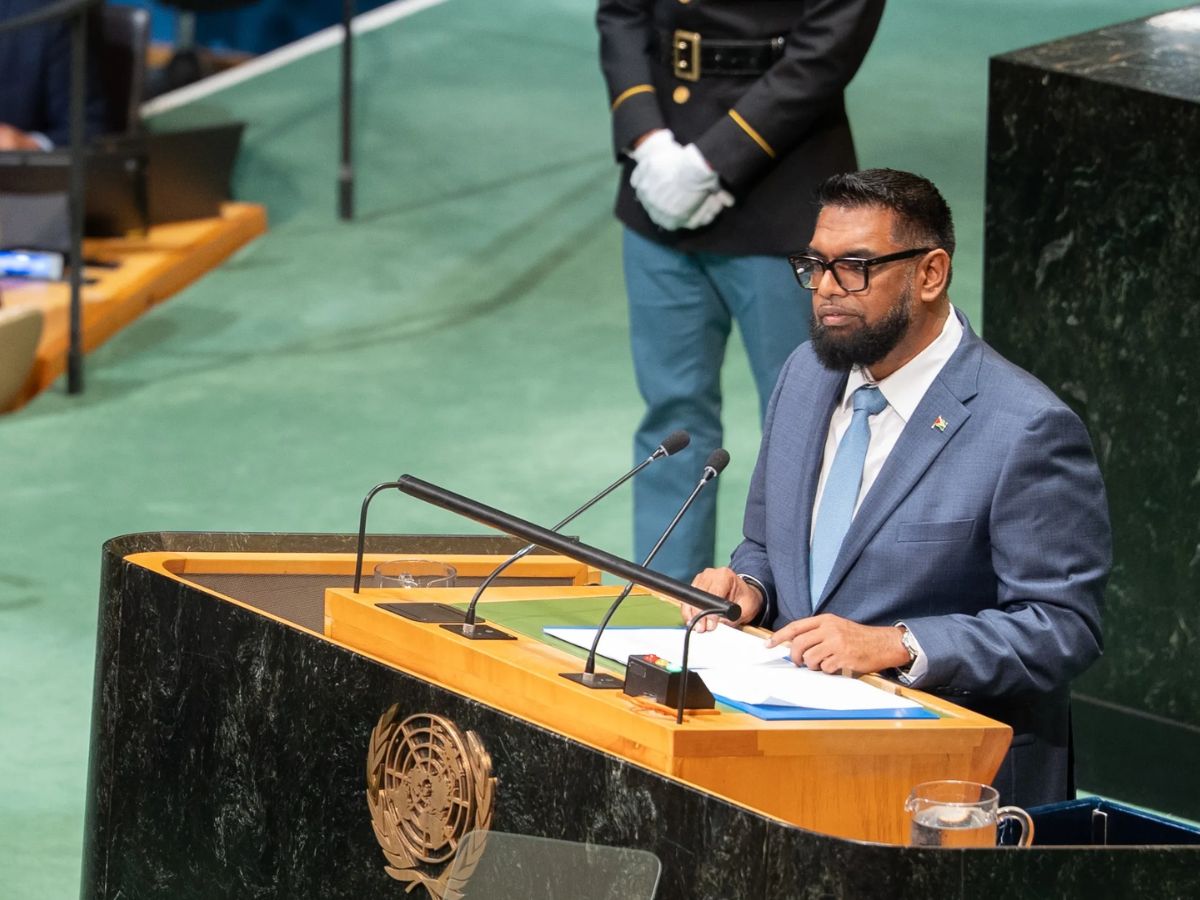
President Irfaan Ali of Guyana called on Venezuela on Thursday to commit to accepting the forthcoming judgment of the International Court of Justice in the long-running dispute over the Essequibo territory. Speaking during the general debate of the 81st Session of the United Nations General Assembly in New York, Ali reaffirmed that Guyana would abide by the court's decision and said Venezuela was bound to do the same under the terms of the UN Charter.
The Essequibo region makes up more than two-thirds of Guyana's landmass and contains substantial oil and mineral reserves that have sharpened the dispute in recent years. Guyana's claim to the territory rests on the 1899 Arbitral Award and the boundary demarcation that followed in 1905. The matter was referred to the International Court of Justice by the UN Secretary-General in 2018, under the framework of the 1966 Geneva Agreement, after decades of bilateral talks failed to produce a settlement.
Since then, the court has ruled twice on questions of jurisdiction, confirming its authority over the case in 2020 and dismissing a further objection from Venezuela in 2023. It has also granted Guyana's requests for provisional measures on two occasions, most recently in 2025, when it ordered Venezuela not to proceed with elections in the disputed region. Full hearings on the merits of the case concluded in May this year, with representatives of both countries taking part.
Ali's address came a day after Venezuela's interim president, Delcy Rodríguez, used the same platform to call for a return to bilateral negotiations. She argued that direct talks under the Geneva Agreement offered the only durable route to resolving the controversy and appealed to Guyana to return to the table. Rodríguez took over responsibility for Venezuela's handling of the Essequibo case following changes in the country's leadership earlier this year.
Ali dismissed that approach. He told delegates that Guyana had turned to the International Court of Justice only after decades of unsuccessful bilateral efforts, and that judicial settlement now represented the sole legal and binding mechanism available. He noted that both governments had participated fully in the hearings held in May and said Guyana intended to honour whatever ruling followed, regardless of the outcome. He pressed Venezuela to make the same commitment, describing this as an obligation under international law rather than a matter of choice.
The Guyanese leader struck a more conciliatory note when discussing what might follow the ruling. He expressed hope that a definitive judgment would allow the two neighbours to enter what he called a new era of relations, free of the tension that has periodically strained ties between Georgetown and Caracas. He linked this prospect to wider regional interests, arguing that a settled border would support economic development and stability not only for Guyana and Venezuela but across the Americas more broadly.
The dispute has at times carried the risk of escalation. Repeated calls from Venezuela for the annexation of the Essequibo region previously raised concerns about the possibility of armed conflict, though leaders on both sides have since pledged to avoid resorting to force while the case remains before the court. Tension has persisted nonetheless, with Guyana's defence forces reporting incidents involving armed men along the Cuyuni River in territory claimed by Venezuela.
With the International Court of Justice's ruling still pending, Thursday's exchange at the United Nations underlined how far apart Georgetown and Caracas remain on the question of process, even as both governments profess commitment to resolving the underlying dispute. Guyana's position, restated by Ali before the full membership of the General Assembly, leaves the court's forthcoming decision as the central point on which the future of the relationship between the two countries now turns.