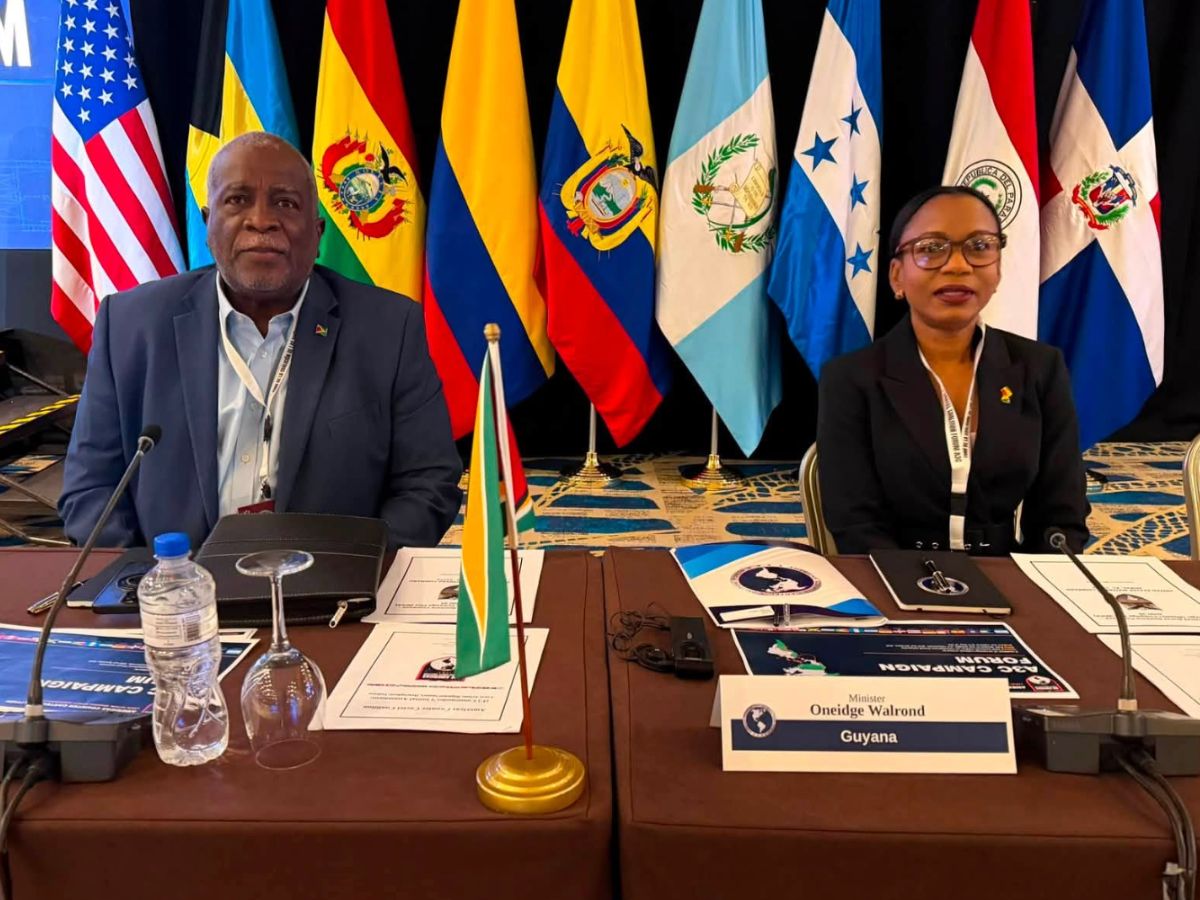
Guyana was among fifteen governments that endorsed a joint statement on Tuesday committing to coordinated sanctions against two dozen criminal organisations operating across Latin America and the Caribbean. The declaration was issued during a meeting of the Shield of the Americas coalition, held on the sidelines of the 81st United Nations General Assembly in New York.
President Dr Irfaan Ali attended the gathering alongside leaders and foreign ministers from Argentina, Bolivia, Chile, Colombia, Costa Rica, the Dominican Republic, Ecuador, El Salvador, Honduras, Panama, Paraguay, Peru and Trinidad and Tobago. The countries later issued a statement pledging to take steps toward joint sanctions, following remarks by US President Donald Trump earlier in the day.
Speaking to the assembled leaders, Trump urged the coalition to impose sanctions on 24 criminal networks, having earlier told the UN that drug cartels are "the ISIS of the Western Hemisphere" and "enemies at war with civilisation". He asked member states to formally designate the groups as threats to regional stability. The list of targeted organisations spans several countries. It includes major Mexican cartels, Colombian armed groups such as the National Liberation Army, Brazil's Primeiro Comando da Capital and Comando Vermelho, and Peru's Shining Path, according to reporting from the summit.
The measures agreed by the fifteen governments centre on three areas of cooperation. The declaration covers security, multilateral coordination and economic protection, including intelligence sharing, access to security technologies, training of police forces and coordination of positions in international bodies. On enforcement specifically, the coalition set out concrete steps rather than broad principles. Member states proposed asset freezes and immigration and visa restrictions for members, associates and supporters of the identified organisations, along with criminal liability for those who knowingly provide material or logistical support to these groups.
For Guyana, the commitment builds on a partnership the government has described as foundational to its security policy since the coalition's inception. Ali has previously said Georgetown regards itself as a founding member of the initiative, which brings together countries committed to upholding democracy, the rule of law and the protection of national sovereignty across the region. He has also framed the country's bilateral security ties with Washington as work in progress, describing the goal as an alliance that is fully integrated rather than merely aligned.
The Shield of the Americas itself is not new. Trump launched the group in March, gathering more than a dozen regional leaders in Florida, as part of a wider push that has included US military strikes on drug boats since last autumn and closer cooperation with Latin American governments. Membership has grown since then. Colombia and Peru joined after Trump-aligned presidents took office in recent months, though Brazil and Mexico remain outside the coalition.
Analysts covering Tuesday's statement have cautioned that its practical effect will depend on domestic legislative processes rather than the declaration alone. Reporting from Bogota noted that the statement was largely symbolic for now, since each country must follow its own legal procedures, and that Colombia's government has asked its Congress to draft the necessary law. That pattern is likely to repeat elsewhere in the region, where sanctions regimes and asset-freezing powers vary considerably by jurisdiction.
The coalition's structure also reflects a divide within the hemisphere. It is composed of governments closely aligned with Trump, including Argentina, Ecuador and El Salvador, whose leaders he has praised or endorsed. Caribbean participation has remained limited, with Guyana and Trinidad and Tobago the only members from the fifteen-nation Caricom bloc, a point that has drawn scrutiny from regional commentators concerned about the implications for collective Caribbean diplomacy.
No timeline was given on Tuesday for when the sanctions measures might take legal effect in member states, and officials have indicated that further ministerial discussions will be needed to convert the political commitment into enforceable action.