
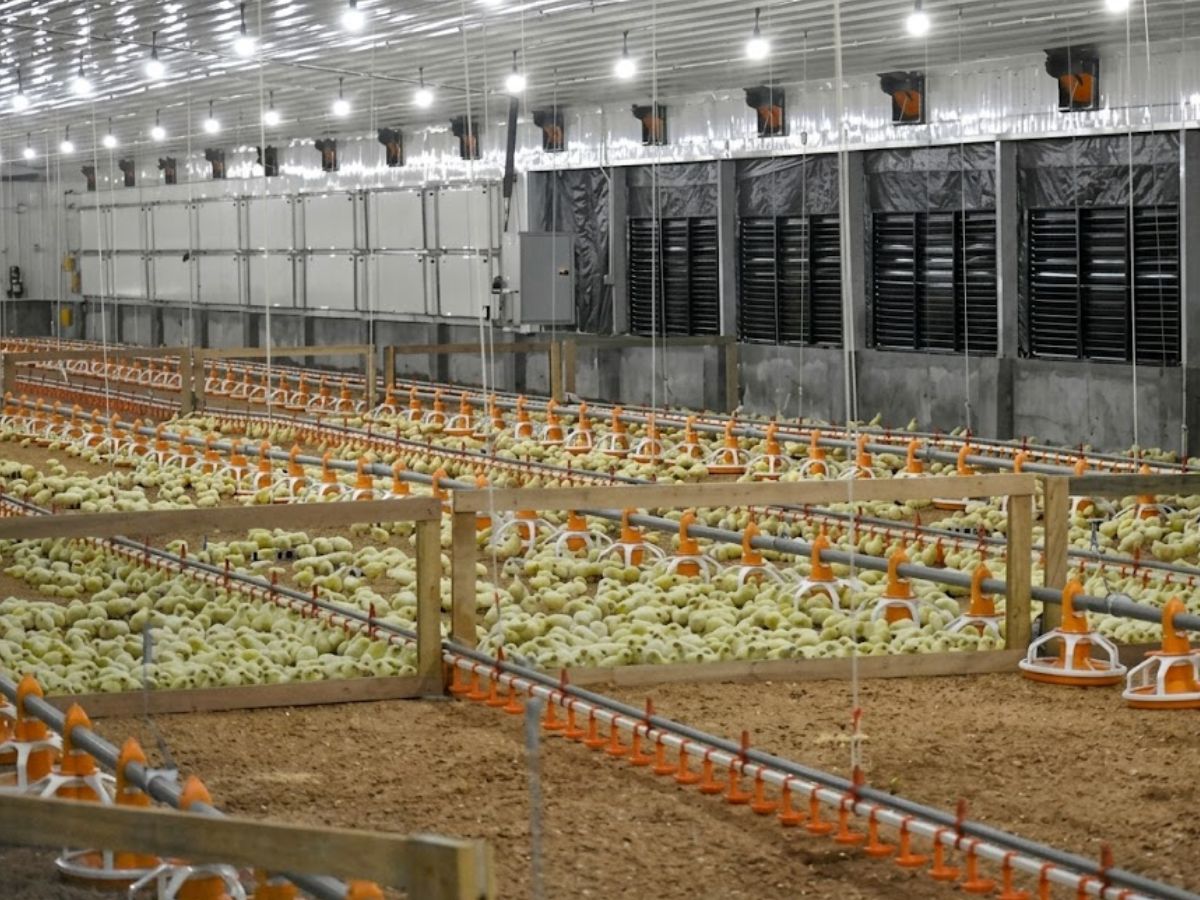
Guyana has commissioned a $1 billion network of tunnel-ventilated poultry facilities in Mon Repos, marking one of the largest single investments in the country's livestock sector to date. The pens, unveiled this week, form part of a broader push to accelerate domestic food production through mechanised, climate-controlled farming methods rather than the manual systems that have long dominated the industry.
The facilities sit within the Agriculture Innovation and Entrepreneurship Programme, a government initiative that seeks to bring younger Guyanese into farming by pairing agricultural work with modern technology. Officials have described the programme as an attempt to shift the sector's image away from manual labour and toward something closer to managed industrial production, in the hope that this will appeal to a generation reluctant to enter traditional farming.
Each pen has been built to house between 20,000 and 45,000 birds, depending on its configuration. Tunnel ventilation systems regulate airflow and temperature throughout the structures, reducing heat stress on the birds and limiting the spread of disease. Under these controlled conditions, broilers are reaching market weight within five to six weeks, a turnaround that producers say improves both flock survival rates and overall yield per cycle. The pens also reduce reliance on manual monitoring, with automated systems tracking feed distribution and environmental conditions throughout the growing period.
Production figures suggest the investment builds on several years of steady growth in the sector. National poultry output stood at 43,726 tonnes in 2020. By 2025, that figure had climbed to 91,382 tonnes, more than doubling in five years. Projections for the current year put production close to 100,000 tonnes, a target officials attribute directly to the rollout of tunnel-ventilated infrastructure and the efficiencies it brings to individual farms.
Agriculture Minister Zulfikar Mustapha said the Mon Repos facilities represented a shift toward a production model capable of meeting rising domestic demand without depending on imports. He pointed to the shortened growing cycles and higher bird capacity as evidence that the technology could be replicated across other regions with similar results. Prime Minister Mark Phillips went further, framing the investment as part of a wider ambition for Guyana's livestock sector to serve as a reference point for other CARICOM member states, several of which continue to rely heavily on imported poultry to meet local consumption needs. Neither minister addressed the cost of maintaining the facilities over the long term, nor how smaller independent farmers might be integrated into a system increasingly built around large-scale, capital-intensive infrastructure.
The Mon Repos site is one of three currently operational under this phase of the programme, alongside facilities in Cornelia Ida and Onverwagt. Officials have indicated that further pens are planned for other regions later in the year, though specific locations and timelines have not yet been confirmed. The government has described the current rollout as the first stage of a longer-term restructuring of the poultry sector, with additional investment expected to follow depending on how production figures at the existing sites develop over the coming months.
For a country that has historically imported a significant share of its poultry products, the scale of this investment signals an intent to reduce that dependency within a relatively short timeframe. Whether the technology delivers the production gains officials are projecting will become clearer as the 2026 harvest cycle progresses and the newer facilities complete their first full seasons of operation. Much will also depend on whether the youth engagement central to the programme's stated aims translates into a sustained workforce, rather than a short-term response to the novelty of the new infrastructure.

.jpg)
.jpg)
.jpg)
.jpg)