
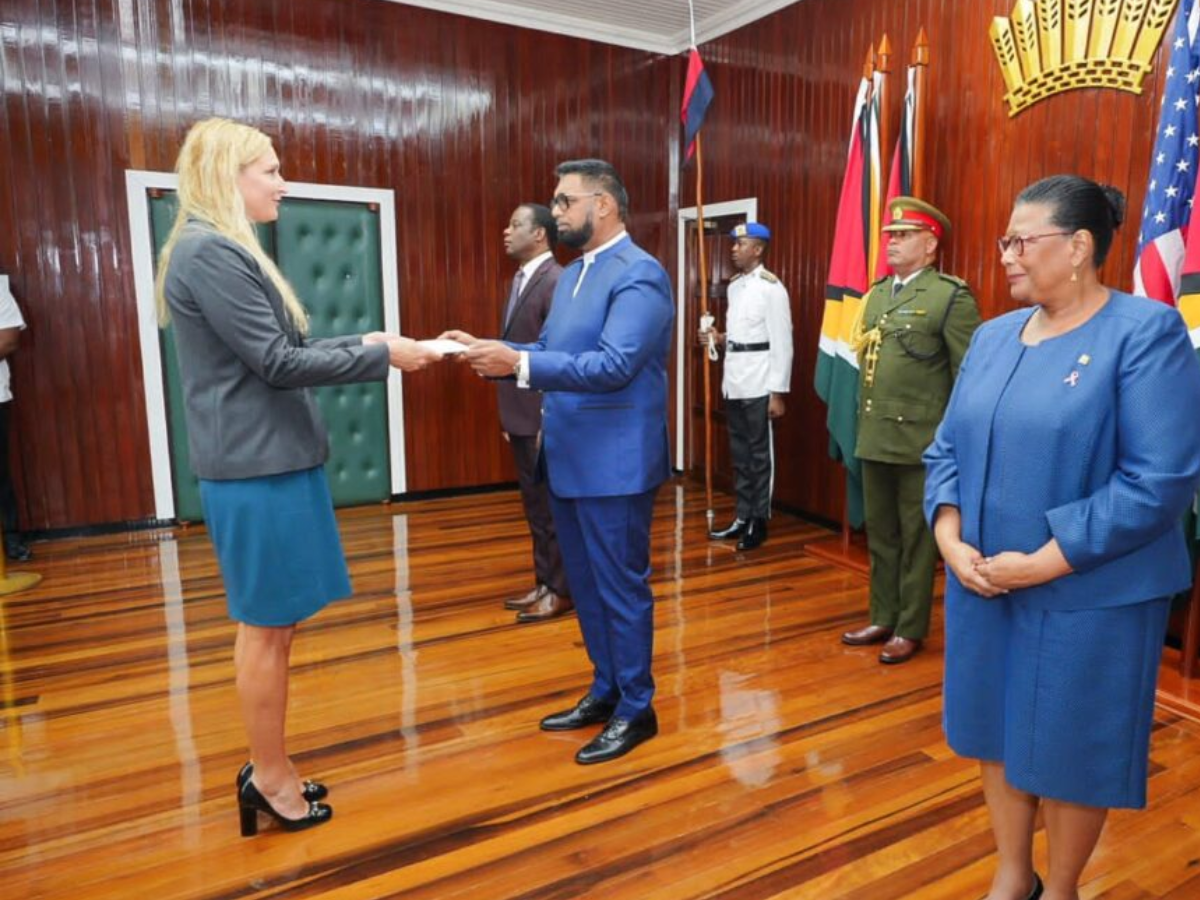
A reception held in Georgetown this week to mark the 250th anniversary of American independence also served as the setting for a rather more immediate announcement. Sixty years after Guyana and the United States established formal diplomatic relations, President Dr Irfaan Ali and US Ambassador Nicole Theriot used the occasion to confirm that the two nations are moving well beyond conventional partnership. The centrepiece of their remarks was a security alliance now described by both governments as fully integrated, aimed squarely at transnational crime and narco-trafficking across the region.
The event, attended by government officials and members of the diplomatic community, was framed publicly as a celebration of history. In substance, it functioned as a platform for outlining a shared security agenda that both sides regard as central to Guyana's stability in the years ahead.
President Ali told attendees that the relationship between the two countries had moved past a stage where security interests were simply aligned. He described the current arrangement as one in which Guyanese and American priorities have become, in his words, seamlessly intertwined. This shift in language points to a closer operational relationship than has typically characterised the countries' dealings on matters of defence and law enforcement.
Ali also spoke of a duty facing his administration to safeguard the country's economic trajectory and its younger population through firmer defence structures. Guyana's economy has expanded rapidly on the back of offshore oil production, and the president's remarks suggested that protecting this growth now sits alongside more traditional security concerns as a policy priority.
Much of the substance behind these statements relates to the Shield of the Americas initiative, a US-led security framework launched in March 2026. Guyana was among the founding members of the coalition, which brings together several countries in the region under a common security architecture. The initiative is built around three practical strands: the sharing of intelligence between member states, cooperation on border security, and the conduct of joint military operations.
For Guyana, founding membership places the country at the centre of a regional response to organised crime, rather than on its periphery. Officials have pointed to this positioning as evidence of the country's growing strategic weight, a status that has shifted considerably since the discovery of major oil reserves off its coast.
Ambassador Theriot, addressing the same gathering, set out the rationale for the alliance in more explicit terms. She identified narco-traffickers and transnational criminal organisations as the principal threats facing the region, alongside what she described only as broader challenges to national sovereignty. Theriot did not elaborate further on this last category, though her remarks were clearly intended to signal concern beyond narcotics alone.
She went on to give an assurance that Guyana would not be left to confront these threats in isolation. American support, she said, would remain available as the security situation in the region evolves. The comment was widely read as a direct reference to tensions Guyana has faced over its maritime border, though Theriot did not name any specific country or dispute.
Security dominated the evening's proceedings, but both officials acknowledged that the relationship extends into other areas. Business ties and healthcare cooperation were mentioned briefly as sectors in which the two countries continue to work together, though neither leader offered detail on current projects or planned initiatives in these fields.
Closing the event, Ali and Theriot each expressed confidence that the partnership would continue to grow over the coming decades. Their remarks suggested that both governments view the security arrangement not as a temporary response to current threats but as a lasting feature of the bilateral relationship, one likely to shape how Guyana approaches its regional posture well beyond the immediate term.

.jpg)
.jpg)
.jpg)
.jpg)