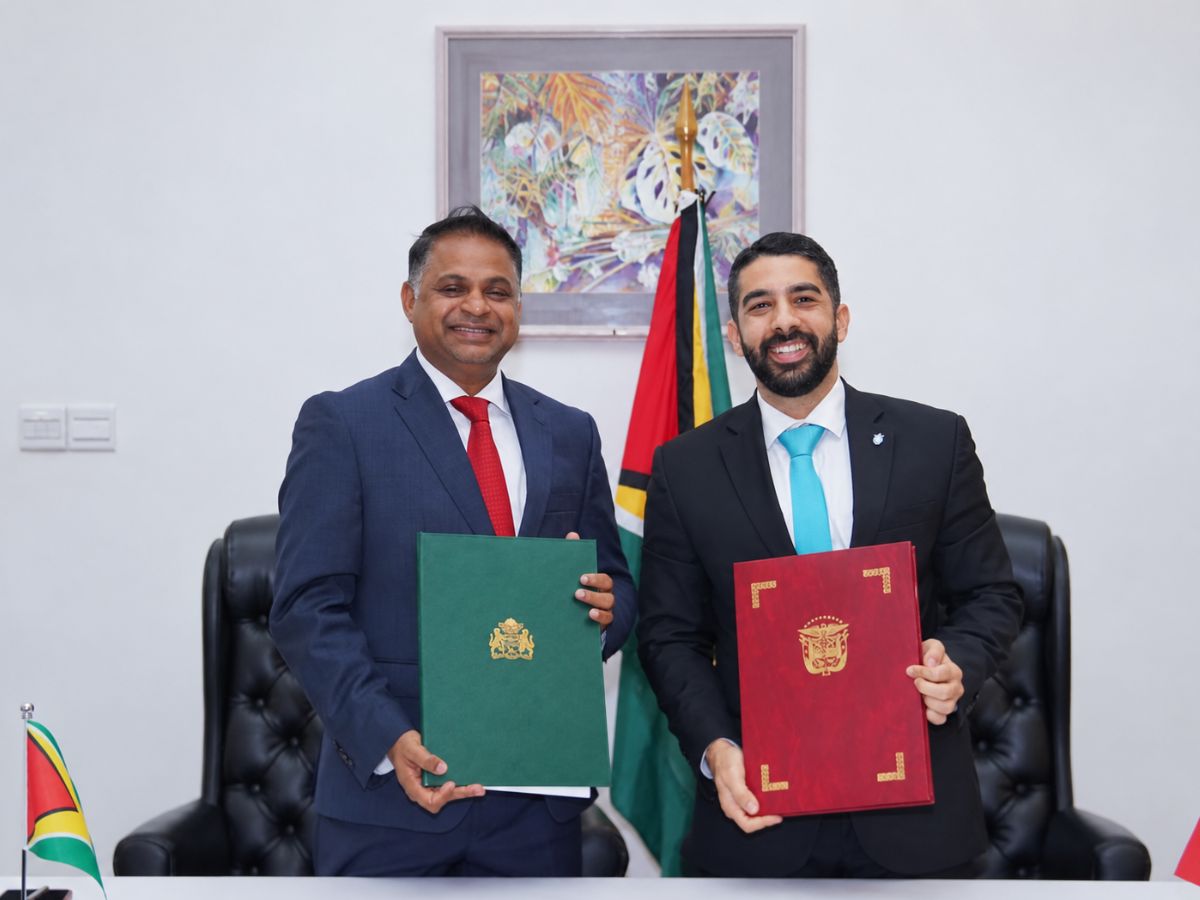
Guyana and the Dominican Republic have signed a Memorandum of Understanding (MOU) on sustainability and decarbonisation in civil aviation. The document was signed by Deodat Indar, Guyana's Minister of Public Utilities and Aviation, and Miguel Amaurys Mejia Capellan, Deputy Director of the Dominican Institute of Civil Aviation. The Guyana Civil Aviation Authority announced the agreement in a release issued on 30 September 2026. The release does not give the date or place of signing. It states that the MOU takes effect immediately.
An MOU is a framework for cooperation between governments. It is generally not a binding treaty, and the authority describes this one as a collaborative framework. The full text has not been published, so the exact commitments it contains cannot be checked.
According to the authority, the MOU aligns with the Carbon Offsetting and Reduction Scheme for International Aviation (CORSIA), which is run by the International Civil Aviation Organization (ICAO). It also supports the global aim of net-zero carbon emissions by 2050. ICAO adopted CORSIA in 2016. The scheme requires airlines to offset growth in carbon dioxide emissions from international flights above an agreed baseline, by purchasing eligible credits. Participation has been voluntary in its earlier phases. The release does not say whether either country has joined the scheme.
The release lists the priorities of the MOU as the adoption of sustainable aviation fuels (SAF), the reduction of carbon emissions and the mobilisation of climate finance. Areas of cooperation include the exchange of technical expertise and capacity building. The two countries also intend to develop CORSIA-compliant Eligible Emissions Units (EEUs). These are carbon credits that meet criteria set by ICAO, and airlines may use them to satisfy their offsetting obligations under the scheme.
The authority says both governments have made a strong commitment to prevent double counting of emission reductions under the Paris Agreement. Double counting arises when the same reduction is claimed twice, once by the country where it takes place, towards its national climate target, and again by an airline that has bought a credit to offset its flights. Avoiding it generally requires accounting adjustments between governments. The release does not explain how Guyana and the Dominican Republic plan to make them.
On governance, a Joint Working Group will meet once a year. Each country will pay for its own activities under the MOU. The release gives no budget and sets no emissions targets or deadlines. It does not name the members of the working group or say when the first meeting will take place.
The release also leaves out several details that would show how the agreement might work in practice. It offers no figures on aviation emissions or SAF use in either country, and it identifies no projects. There is no account of how emissions units would be generated, verified or traded, or of who would buy them. The authority calls the MOU a significant step and a milestone in regional collaboration. Those are its own descriptions, and the document itself, as reported, contains no measurable outcomes against which the claim can be tested.
Climate finance is the least developed part of the announcement. The release says the MOU will support the mobilisation of finance for aviation decarbonisation but does not say where the money would come from. Since each country is responsible for funding its own work, any large investment in fuels or credit schemes would depend on separate decisions and on outside partners that the release does not name.
Several points remain to be settled. The date of the first Joint Working Group meeting has not been announced, and there is no indication yet of whether projects have been selected. The authority has not said whether the text of the MOU will be made public. Until those details emerge, the agreement stands as a statement of intent between two governments to work together on aviation emissions, with the practical results still to be defined.