
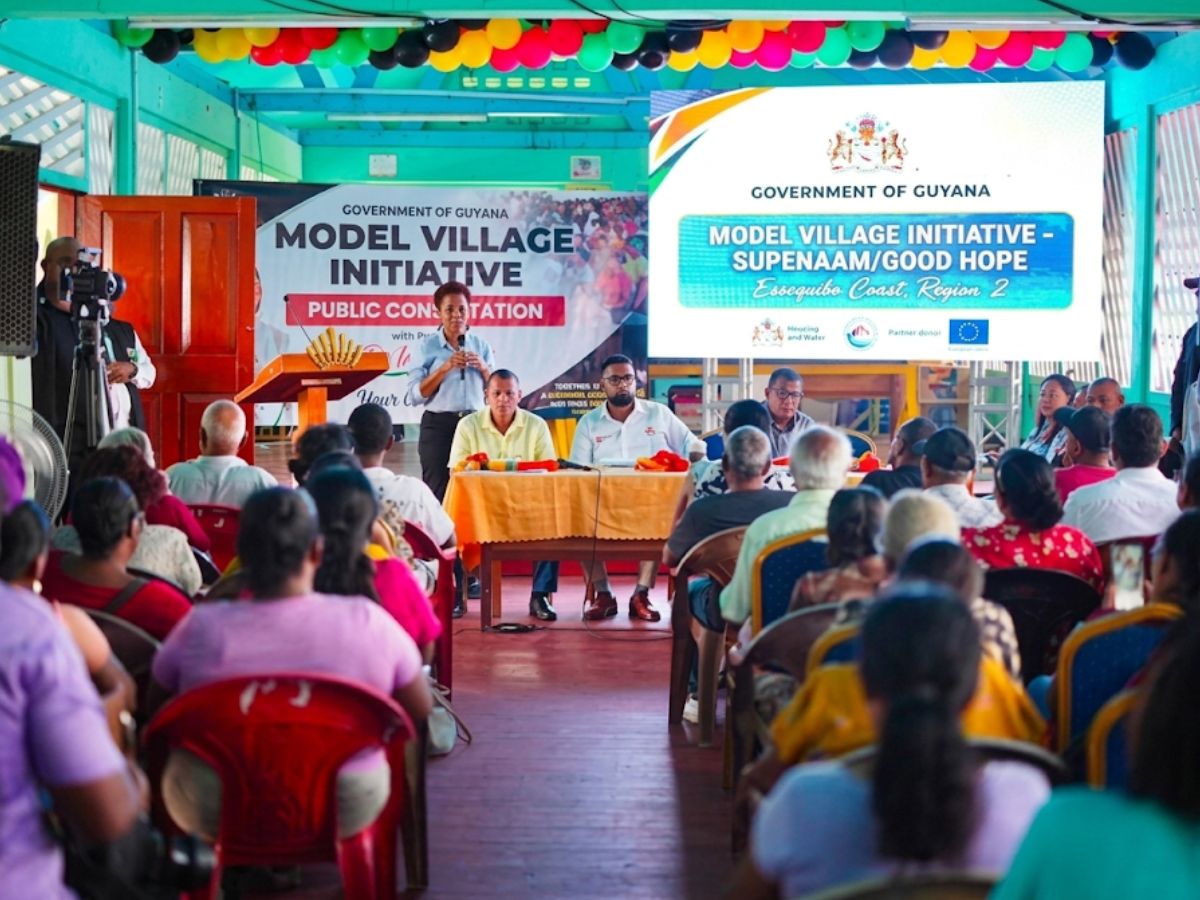
The government has outlined plans to establish a commercial poultry production hub in Region Two, Pomeroon-Supenaam, in an effort to reorganise how local farmers raise and sell birds. President Dr Mohamed Irfaan Ali introduced the proposal during recent community consultations held in Suddie and Good Hope, describing a shift away from scattered household farming towards a consolidated, higher-output system.
At present, poultry production in the region is dominated by small backyard operations, many of them situated within residential neighbourhoods. This arrangement has long created friction between farmers and their neighbours. Odour, noise and waste management associated with keeping livestock close to homes have prompted repeated complaints, and local authorities have had to mediate disputes over land use in areas never intended for agricultural activity.
Beyond the social cost, the current model limits how much farmers can actually earn. Operating independently, without access to shared infrastructure or bulk purchasing power, small producers struggle to expand beyond a modest scale. Feed costs, equipment and veterinary support are typically negotiated individually, leaving farmers with thinner margins than a coordinated operation could achieve.
The proposal put forward by the President centres on relocating dozens of independent farmers into a single, purpose-built facility away from residential areas. The Guyana Development Bank has been identified as the intended source of financial and structural support for the transition, though the terms of that backing have yet to be finalised.
The President offered a working example of how the cluster might function. Roughly 40 individual farmers could be brought together under one operation with the combined capacity to produce up to 25,000 birds. Each participating farmer would retain a financial stake in the enterprise rather than surrendering ownership entirely, allowing them to benefit from the scale of the combined operation while still holding a personal interest in its success.
Officials argue the arrangement would deliver several practical advantages. Farmers operating within a shared facility would gain access to modern methods and equipment that are difficult to justify on an individual basis, along with the purchasing leverage that comes with buying feed and supplies in larger volumes. The expectation is that this would translate into higher and more consistent incomes for those who join.
Removing poultry operations from residential areas is also expected to ease the disputes that have accompanied backyard farming for years. Neighbours currently affected by odour and noise would no longer share a fence line with commercial livestock, and local authorities would be freed from adjudicating the zoning conflicts that have periodically flared in the region.
The Region Two proposal sits within a broader government strategy for agriculture, which has emphasised consolidating resources, upgrading rural infrastructure and bringing more of the sector into a formal, regulated structure. Officials have pointed to similar consolidation efforts in other parts of the farming economy as evidence of the approach the administration intends to pursue more widely.
For now, the poultry hub remains a concept rather than a funded project. Several practical steps must be completed before construction or relocation can begin. A suitable site for the facility still needs to be identified and secured, a task that will involve assessing land availability, access to utilities and proximity to existing farming communities in the region.
Lending arrangements with the Guyana Development Bank will also need to be finalised, including how funds will be disbursed to individual farmers and what conditions will attach to that support. Equally important will be the drafting of a legal and operational framework governing the cooperative structure itself, setting out how ownership shares are calculated, how profits and losses are distributed, and how the facility will be managed on a day to day basis.
Government officials have not given a timeline for when these steps might be completed, though the consultations in Suddie and Good Hope suggest the proposal is intended to move beyond the discussion stage in the near term.

.jpg)
.jpg)
.jpg)
.jpg)